
01 Sep, 2026


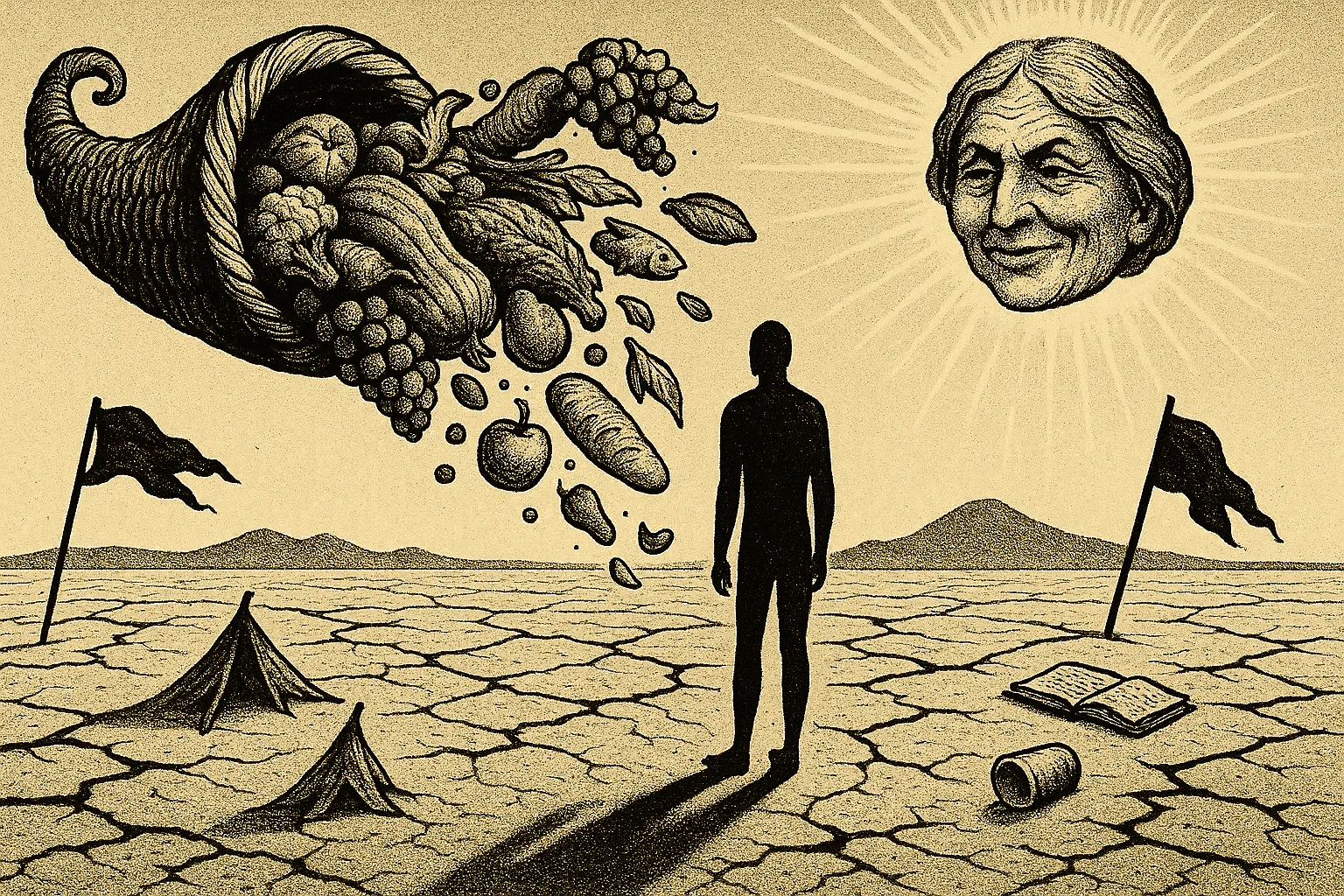
“There are places,” Camus writes, “where reason dies so that the truth of its negation may be born.”
Let me pause for a moment, dear reader, so you can register that this thought was not penned by a Bulgarian. And then let me pause once more to add that what he says could easily—indeed should—strike you as profoundly Bulgarian. Much like the rest of the outrageously beautiful, feverish, unironic, passionately beating reflections in his essay collection Summer, published at a time when Bulgaria, draped beneath the flattening cover of real socialism, could still indulge the illusion that it belonged to the “cooler Europe”. A rather distant time, no doubt.
Or then again—perhaps not.
It depends on where you stand. The prejudices that held that glorious era together—prejudices born of people who sincerely believed in the immeasurable supremacy of the social over the geographical and the national—lost their force with disarming speed. Today they look so young and green that they almost tempt us to feel older and wiser than all those bearded prophets who once proclaimed the coming unification and universal embrace of the nations…
But let’s shut that smug feeling up before it grows any louder. Whatever it is we believe in now (and what is it, exactly?), tomorrow will seem just as callow to those who come after us as those old sermons about world government seem to us today.
So let us return to summer—and to Camus. Listen to this:
“…a man convinced that tomorrow will be like today, and after that, all the days to come.”
Whom do you imagine he means? And then:
“For to be aware that you exist is to expect nothing.”
Tell me honestly—doesn’t everything this Frenchman (or perhaps Algerian?) says sound as if it sprang from the most hidden, most carefully buried, yet most truthful corners of the Bulgarian soul—parched, overparched even, by the gusts of so many winds, each hotter than the last, whether blowing from east or west?
I know my question is thoroughly rhetorical—more than that, I wouldn’t have started writing this essay if I didn’t think I already knew the answer. And still, I ask it with the secret, slightly malicious pleasure of a man preparing to reveal to the public yet another case of copyright infringement.
Yes, dear reader, it turns out that even something as inseparable from the Bulgarian self-image as quiet despair was already discovered—and wonderfully described—by someone else before us. Yes, we’ve been beaten to it yet again. And not only here: an astonishing number of things we like to imagine as purely Bulgarian—those perpetually worried looks, the constant complaining, the unfeigned absence of hope, even the quiet disappearance of the future tense from the forms of thought we take seriously—were known to others long before we arrived.
Let me add at once that I write these slightly ironic outpourings mainly in the hope that, at this very moment, you will shrug and push aside what I’m offering you, muttering something like: “Right, here’s another clever fellow trying to convince us we’re further behind than we thought. Thanks—and may it return to you!”
This, dear reader, is the one reaction I would welcome with joy and respect, for it would reassure me in my illusion (shall I say “faith,” and expose myself in all my naïveté?) that there is still something left in Bulgaria and in Bulgarians of that sourly mocking stubbornness that carried countless generations through hardships beside which our present looks like a rose garden. And which, if you ask me, is the first thing I recognise whenever the topic “What is the Bulgarian?” arises—that is, “What am I?”
(Don’t be quick to accuse me of superficiality, dear reader; arriving at this apparent tautology took more than ten years and uncountable efforts. Healing the ulcer from which many Bulgarian intellectuals have long suffered—seeing their people and their country as something deserving only contempt, and therefore being forced either to renounce them or to admit that they themselves deserve nothing better—was not an easy task.)
So. What I want to discuss here is what I call “the prejudices of the time,” or at least those I feel I’ve managed to glimpse—pardon the presumptuous phrasing. Most of them are constantly being reshaped, reworked, replaced by newer and more palatable prejudices—but whether these amount to genuine new values or merely a half-conscious attempt at compensation, compensation, compensation… that I leave for you to decide.
And so, here is the first of those prejudices:
Bulgaria is an “old” country, and the Bulgarian people are an “old” people.
The time when we, with great pathos and much chest-thumping, celebrated the thirteen-hundredth anniversary of the founding of the Bulgarian state is still not so far in the past that I need to explain at length what I mean. I don’t know whether the boastfulness surrounding that much-vaunted event was solely the result of the natural tendency of one-party systems to present themselves as the culmination of something especially grand, or whether more serious reasons lay behind it—such as the (again natural) tendency of any nation fallen into historical disfavour to seek every possible occasion to shove under the world’s nose its cherished idea of ancient lineage…
I don’t know, I repeat. But it seems to me a fact that in this regard we are, at the very least, typically blind (and continuing to blind ourselves). Looking at our history, I find above all that the greater part of it passed under foreign rule, and as for the free exchange of ideas, its duration is literally ahistorical—even if we include the last ten or twelve years, which, following the logic of every local beginning, are marked more by Balkan fervour, chaos, and uncompromisingness than by good taste, depth, or even our otherwise not lacking wit.
Bulgaria—an old country? Or, in other words: Bulgaria—a mature country? I don’t know what you think, but when I hear such words, I’m inclined to laugh. Isn’t it in fact true that all the countries of the Balkans are obscenely young, regardless of how ancient a lineage they might flaunt (forgive me, Greek neighbours, but I include you too in this count)? All of us face the task of outliving the not-so-pleasant reality of a historical development linked to cultures and traditions that differ sharply from those shaping the present of the continent we belong to geographically—and to which we strive with all our might to be counted, stubbornly ignoring its disdainfully wrinkled nose.
I don’t know how acceptable this statement will seem to you, but if you allow me to develop the thesis a little further, I’ll arrive at the point where Bulgaria’s youth might not be entirely a disadvantage. And a disadvantage, in this situation, clearly exists, but in my view it does not stem from the fact that we are what we are, but only from our efforts to present ourselves as something different—especially in our own eyes. It’s well known that every attempt to distort and adapt reality to fit one’s own notions leads to psychological problems—and in that regard, I think, nations are no less an exception than individuals. And Bulgaria, striving to see in itself an old, mature European country (a nation, a culture), is by definition condemned to continuous torment—just as much as the other Bulgaria, the one that rejects every attempt at comparison with Europe, preferring to listen to its chalga[1].
Is it not already time for a national psychotherapy?
Another rhetorical question, another presupposed answer. And yet, let’s suppose you grant me a bit of intellectual credit and are willing to follow me in considering the implications of this rather unflattering assumption: Bulgaria and the Bulgarians—a young people, an immature culture?
“Well, what of it?” my fellow liberal intellectuals might say. “Even children know this! Is that all you see from over there in Germany?”
Fine, here’s what I see: above all, a place so saturated with the expectation of the next miracle that its impatience—a natural companion of all youth—has already begun to turn into some kind of absurd negation of itself, a complete rejection of concepts like “a better future” or simply “later,” and where, consequently, the present has become the only meaningful form of existence—an insatiable Chronos, gnawing his children down to the bone before they are even born, before they are even conceived. If you want to lose the trust of a Bulgarian, talk to him about “later.”
Schooled by what he (probably rightly) considers the only possible experience, our compatriot will give you a sideways look and, depending on the situation, will either ask you to pay in cash or suggest that you take your leave before something unpleasant happens to you. (With one small exception—if you come from some “European” country, he may agree to treat your promises as a kind of deposit—but even in that case, his patience will have run out long before eight hundred days have passed[2], so don’t try building projects that stretch even a little into the future: your credit will certainly not suffice.)
The natural idea of development and progress has already completely lost, in the eyes of Bulgarians, any measurable connection with human life. Tell someone that things will improve, and if you get a response at all, it will likely be: “Maybe, but we won’t be alive to see it.” And in this I once again see an indication of our nation’s infancy: first, in the ease with which it discards all the lessons of its seemingly long history, and second, because the voluntary renunciation of the idea of any future (which inevitably entails a rejection of things like spiritual growth, wisdom, and experience) in practice amounts to an embrace of the idea of eternal youth—for only youth, with its overflowing carefree energy, can survive in a world where there is no room for anything other than reverence for the power of fate.
So, Bulgaria is young and immature. Perhaps. And who cares? Exactly—precisely. The refusal to learn the lessons of old age, however temporary by its very nature, is nonetheless something real, something one can begin with. Youth, as we know, is not merely naïve. If you’ll allow me to quote Camus once again: “A young man looks the world straight in the eye. It is not yet time for him to form an idea of death or nonexistence, though he already senses their horror. Perhaps that is youth: the unbearable ‘aloneness’ with death, the atavistic fear of an animal in love with the sun.”
It sounds not only beautiful but—at least to me—hopeful. Sooner or later Bulgaria and the Bulgarians will have to remember the Apostle’s line, “I am alone, there is no one else,”[3] and recognise that they are in a world far too preoccupied with its own worries and problems to offer them anything more than momentary attention or, as the currently fashionable Bulgarian–American romance encourages them to hope, even preference. In other words, they will have to open their eyes, however blinding the glare of the Balkan sun may be.
At which point—or so my naïve hope goes—perhaps the other advantages of youth will rise to the surface: the absence of illusions, or at least of those tied to the perpetual expectation of some strong, liberating, guiding hand; the eternal readiness for a fresh beginning (supported, one hopes, by a bit more patience and endurance); and the energy, the eager hunt for new and ever more demanding trials, all in the name of what that forgotten and contemptuously rejected old age long ago achieved: a completed self, the calm and confidence that can come only from work well done, the maturity and independence of judgement, and finally—equality earned, not bestowed.
I hope you now see what my simple credo is: before we can begin to grow, we must first recognise that we are still green—without shame. It sounds elementary, but even so, I would ask whether we are truly willing to take this claim seriously, with all its consequences. I, for one, have my doubts. Just look at whom we try to measure ourselves against, where our eyes are constantly turned. Once again—old Europe; once again—that culture and those traditions, the link to which we lost centuries ago, if we ever truly had it. Or America, which, though not quite so old, has inherited those same European traditions, and thus differs from us as oil from water.
Recently, riding in a taxi in Sofia, I listened to the driver’s angry complaints about the filth and disorder. “Is there another capital in Europe that looks like ours?” he asked. And when I cautiously tried to suggest that perhaps we ought to look toward the Near East if we were truly intent on comparing ourselves to someone, he looked at me, offended, and said: “Is that what we’ve come to—comparing ourselves to them?”
Typical, isn’t it? On the one hand, we want to be honest with ourselves; on the other, we avert our gaze the moment we touch something that feels un-European, un-Western.
Which brings us to the second prejudice I’d like to prod here:
Bulgaria is inextricably linked to the European cultural tradition—it is part of Europe not only geographically, but historically and culturally as well.
Hmm. And is that, in fact, self-evident? Any glance at the humanly neglected, battered body of Bulgaria—slowly vanishing beneath mountains of industrial waste—ought to make us pause before speaking loudly about culture and tradition. Frankly, if I were to compare dusty, inhospitable, smoke-stained Sofia with any other European capital I know, the only fitting examples would come from our closest neighbours (whose notions of cleanliness and hygiene, for whatever reason, happen to resemble our own).
I recall how, about ten years ago, I watched a young and handsome Turk in Istanbul flirting with two Russian girls and passionately—even angrily—trying to explain to them that the proper place for ice-cream wrappers was… the ground. Tell me—do you not already feel that suspicious sense of déjà vu? If not, just take a look around.
My wife, suffering from the all-too-typical German lack of flexibility, still cannot understand what makes people here so irresponsible toward the world around them. And since she quite rightly sees no need for elaborate arguments in defence of cleanliness, she simply says that the opposite “just isn’t nice.” Tell me—how am I to explain to her that, before people can arrive at the idea of what is “nice,” they need senses unburdened by the pressure of a life in which survival—not peaceful existence—is task number one?
And isn’t what Bulgaria is dragging itself through right now simply the past of old Europe? Elementary truths, no doubt. Elementary—but, for some reason, strangely difficult to absorb, both for a well-fed Europe and for a hungry Bulgaria.
But is that all that separates us from Europe? Ha! Go to the beach and look around! What you’ll see, of course, are mostly bodies freed from the protective cover of clothing. Naked—or nearly naked—bodies. A part of the truth, in other words. And if, like me, you arrive from afar and look with eyes no longer accustomed to the local scenery, you’ll immediately notice that the beautiful, well-kept, pleasing-to-the-eye bodies mostly belong to women.
The men, by contrast, look rather bloated and, as a rule, bring to mind Grandpa Karavelov and his two melons…[4]
Why is that, you ask? Very simple: women are forced to undergo daily quality control under the gaze of male approval and (clever creatures!) have somehow managed to extract the best for themselves from this otherwise unbearable burden. Men, by contrast, are free of all control—they live in the Balkans.
So much for gender equality—Europe’s great achievement of the last fifty or sixty years. But is that all? What about the eternal outwitting—the supreme Balkan specialty? What about the value of time, which here, unlike elsewhere, costs nothing? What about the beating of children (and their mothers too, let’s not abandon that old tune)? What about the constant displays of force and spite, especially behind the wheel?
Shall I go on—I, the guest in my own homeland? Or are these ABC truths already beginning to bore you?
Very well. But what happens if, just for a moment, we try to be brutally honest with ourselves and pronounce the words that make us twitch even in our sleep: We are not Europeans!
I mean saying them without bravado—not to insult or prod ourselves, but simply as part of a thought experiment, just to see what happens if we dig a little deeper into this unpleasant assumption.
“So what?” you might say. “Do you think you’re helping us? Everyone knows what we’re not. That doesn’t change much—at least not before we know what we are. Can you tell us something about that, countryman?”
A difficult question, I admit. But if we are to speak of what I personally find defining, we must at once return to the title of this text: the heat, dear reader.
The scorching heat—mother of sharp contrasts and stepmother to half-tones. That same heat which sharpens the senses to the point of pain, whose reckless generosity often borders on wastefulness. Bulgarian nature, like its inhabitants, offers beauty in such abundance that the less prone-to-exaggeration northerners would surely call it “profligate.” Here, scales do not measure precisely by definition (for what is the point of precision where the usual companion of poverty is reckless squandering?), and the intensity of life sometimes reaches dimensions hardly compatible with ideas like “tradition” or “history.”
Bulgaria—a curious weave of splendour and destitution, superlatives and complexes, sensual pleasures and broken hopes, brazen self-display and provincial shyness, eternal beginning and ceaseless sobering end…
In Europe, there are countless ways to hide from the truth of one’s inevitable fate—from the thick monastery walls to the round sums of social security. In Bulgaria, by contrast, everything demands youthful strength and endurance, a constant influx of fresh, daring blood. Thus deprived of the softening buffer of illusions, we have made our highest virtue out of directness—the ability to stare the inevitable straight in the eye.
In Germany—a country instructed by painful experience—the place of this highest virtue is taken by caution. Not so in Bulgaria—where half-tones do not exist, the difference between caution and cowardice is too negligible to waste one’s time on.
I try to understand that accepting such a people and such a worldview is not easy—even for themselves. Their geographical position, together with the all-too-frequent shifts of cultural influence and domination, has brought them to a condition where their usual way of life resembles the endless swing of a pendulum—constantly touching but never resting on any extreme, turning their existence into a peculiar, home-grown form of contradictio in adjecto.
Naturally, this makes defining the Bulgarian character exceedingly difficult—hence our tendency to bow, almost to the point of servility, before nations and cultures we barely understand.
Infinitely hospitable, we simultaneously harbour a solid dose of xenophobia (how else but with the phrase утепай го!—“take him down!”—can one describe the treatment of foreign tourists in Bulgaria whenever they stray from the safe paths of tourist zones, whether they encounter taxi drivers, waiters, or police?).
Not foreign to reason, the Bulgarian nevertheless delights in opposing it with his own version of “wooden iron”—the peculiar local form of shy passion. Entirely devoted to the present, he cares little for the formative and ennobling force of myth and religion—and yet he has, time and again, given his life for faith, simply because its removal would be incompatible with his deeply rooted provincial stubbornness.
Revering learning and knowledge almost to the point of fetishism, he is at the same time capable of watching with complete indifference as his national cultural wealth melts like March snow (just look at the state of our historically most important cultural nuclei—the schools and libraries!).
In short: in some strange, hard-to-describe way, the Bulgarian has managed to answer both sides of Hamlet’s question—to be and not to be, at the same time.
Which, it seems to me, brings me to the third and final prejudice—this time one that comes from outside, from the eyes of those who observe us from afar:
Bulgarians are a people without a defined character, swaying according to the gusts of the moment’s cultural or political wind—the par excellence ally of anyone who wishes to lose a war, whether planned or already under way.
When, at the beginning of this year, the well-known American journalist Maureen Dowd published in The New York Times an article whose content could more or less be summed up in the few lines above, I was outraged—at least at first—to the depths of my soul. Bulgarians—lackeys? What is this lady thinking? Unheard of! Outrageous!
Then, once my irritation began to subside, a familiar saying from back home began knocking in my head—you probably know it: “Well, if people start saying that a dog eats shit…”
Like it or not, I must admit—if you ask me, the little dog must have done something to earn the reputation.
And so it is with Bulgaria’s international standing. The facts—however tendentiously selected by Mrs Dowd—remain facts. Bulgaria: the eternal satellite—first of the Germans, then of the Russians, now of the Americans. Bulgaria: the model student who gives everything to win the approval of the next teacher. Bulgaria this, Bulgaria that—always some petty search for advantage, always first in line to wag its tail before the powerful of the day…
It’s hard to offer any respectable reply to such accusations—it doesn’t quite work; it sounds either hollow or simply shameless. And, as is well known, accusations that cannot be answered respectably usually turn into self-accusations.
And might it be that I am the only one willing to admit that Bulgaria and the Bulgarians have indeed given ample grounds to be thought of as lacking in character? For that matter—do we consider ourselves people of character? Before you answer, please look again, a little more deeply, into the eyes of the first passer-by you meet on the street.
Ugh—sorrow, my sorrow!
But no, that cannot be!
After all, is this not the very same people who—leaving everything else aside—managed to preserve themselves through five hundred years of foreign rule? Is this not the same people who, in their modern history, accomplished something few other European nations managed to do—the rescue of the Bulgarian Jews during the Second World War, the bold and wholly unexpected defiance of an otherwise obedient student against his teacher; the pigheadedness that drove mighty Germany and its Führer into fury, to foam at the mouth?
How do these things fit together? How do we separate the wheat from the chaff, how do we tell what is true and what false? Or are we once again meeting another example of that Bulgarian contradictoriness we have already discussed at length?
Ah, no!
This time I refuse to accept the convenient logic of dialectical contradictions—this time I insist on either—or!
In the end, this concerns the Bulgarian character—my own character, damn it! I cannot leave things halfway; I need something unambiguous, even if that something is nothing but shame. Full stop.
And here, amid the miniature lightning flashes of my impotent anger, something suddenly flashes before my eyes—something endlessly simple and clear.
Of course!
The Bulgarians show their true character only in negation.
Once again, the heat, my dear ones. Once again, the logic of the quick, unambiguous blow; the total indifference to safety and to the future; the temperament that, with childlike ease, smashes every dam of reason.
True, we don’t do this very often. To show our horns, we must first be driven into a corner, into frenzy, into a state where we can no longer save our honour by any means less drastic than silently placing our necks on the chopping block.
But if it comes to that—oh, if it only comes to that!
Then, my dear ones, we simply do it. Quietly. Without the usual cunning, boasting, or sidestepping.
Then we are simply ourselves.
⸻ ❦ ⸻
My father—my favourite Bulgarian—died a few months ago, standing. In doing so, he gave his sons the last—and perhaps most important—example of his life, though that is not what I want to dwell on here. Bai Mitko Enev died while trying to climb the steps at the top of which an ambulance was waiting, promising salvation or at least a little hope against the noose of a heart attack that, as you will have guessed, had already fatally tightened around him. He did not manage to climb them, but before that he refused the help of the medics and neighbours who insisted on laying his heavy body on a stretcher.
I hope you will forgive the proud words, but I see in this a beautiful act of free will, a truly Bulgarian stubbornness that would rather show death the middle finger a hundred times over than bow its head before the inevitable. And perhaps somewhere here lies the germ of what allows me to live in Germany without feeling uneasy every time I have to explain that I am Bulgarian. “Be whoever you wish, but keep at it to the very end”—something like that runs through my head whenever I think of my father’s death. That, and the hope that my children, even if they do not speak Bulgarian, still carry within them something of their grandfather’s hard-headedness. And of his broad soul, which insisted, all his life, on looking the other way when it came to life’s troubles.
On the other hand, my family is currently occupied with another, long-announced death. My wife’s grandfather—a German from the Baltic fringes of Germany, dry and tough as a strip of dried fish—lies on his deathbed, surrounded by the care and attention of relatives full of love and respect. May his bed be light; good Erwin has earned everything he receives. He has passed through all the circles of war’s hell—on the Eastern Front, no less—then through the command-ridden years of German socialism, he raised four children, and until a few months ago he was still knocking back half a schnapps a week, rinsing it with a beer or two. I say this only to make clear that I respect this man in all seriousness—people like him, tough and time-proof as beech planks, are the reason Germany and its inhabitants have become a myth for Bulgarians (above all for those who do not know them well, but we have already spoken about that).
I repeat: I have great respect for Grandpa Erwin. I say it, and I hasten to add that something in me resists and cannot quite accept, without reservation, the way he is dying. I ask myself whether these words conceal nothing more than the arrogance of youth, even if I no longer think of myself as particularly young. I do not know, of course, but I still find this death somehow too reasonable and dispassionate, too German—let me spit the stone out.
Years of wrestling with philosophical texts have taught me to understand that accepting death may be one of the core achievements of our civilisation—but my atavistic Bulgarian instincts rebel against this foreign wisdom and make me shudder whenever I try to imagine the reality of such a slow farewell. To lie endlessly on a special mattress paid for by an expensive insurance policy, to feel the last sparks of life draining from your body along with the warm trickle between your legs, to feel fear slowly but surely turning you from a person into an animal… brr, may God spare me the wisdom of such acceptance!
“The horror, the horror,” whisper the whitened lips of Colonel Kurtz in Apocalypse Now—and that is the only image that flickers before my eyes when I think of death in its “civilised” version.
⸻ ❦ ⸻
I began with Camus; I would like to end with him as well: “The surest sign of youth may be the beautiful tendency toward simple happiness. And above all, the eagerness to live faster, even to the point of wastefulness.” Perhaps in such words, my dear ones, one could express another side of the Bulgarian character. Or of the Bulgarian fate—who knows?
In any case, when I think of my homeland, I often close my eyes and dream like this: “What would happen if, suddenly, all of us—but truly all of us, all, all, all—were to forget the howls of television, newspapers, radio, and for a brief moment wish for the impossible (which, in our confused time, seems simply to mean: to be Bulgarians)?” And then I remember that “maybe, but we won’t be alive to see it,” and I return once more to reality.
Then again—who can say? The impossible, they say, is merely a form of the possible stretched over a span of time beyond the reach of our eyes. Time which—this is my hope—sometimes flows slowly, and at other moments quickly, far more quickly than we can imagine.
So then, my dear Bulgarians, let us be realists and think more often of the impossible. Who knows—perhaps precisely in this—and only in this—lies our chance, at last, to make of ourselves what we already are.
Who can say?
Sozopol, August 2003
[1] “Chalga” refers to a popular Balkan musical genre that blends folk motifs with pop, Oriental, and turbo-folk elements. In Bulgaria the term carries strong social and cultural connotations, often symbolising kitsch aesthetics, commercialism, and a broader attitude of anti-intellectualism or defiant populism. It is frequently used as shorthand for a whole worldview rather than just a style of music.
[2] The phrase refers to the famous promise made by Bulgaria’s then–prime minister, Simeon Saxe-Coburg-Gotha, who in 2001 publicly vowed that his government would significantly improve life in the country within 800 days. The pledge became a national meme—first hopeful, later ironic—symbolising the country’s chronic impatience and its repeated disappointments with political saviours.
[3] “The Apostle” refers not to a biblical figure but to Vasil Levski, Bulgaria’s central national hero, popularly known as the Apostle of Freedom. According to national lore, his last words to his Ottoman interrogators before being hanged were: “I am alone, there is no one else.” The phrase has since become a condensed symbol of moral solitude, responsibility, and uncompromising civic courage.
[4] The image refers to Lyuben Karavelov’s novella “Мамино детенце” (“Mamma’s Boy”). In its opening pages, the character Нено чорбаджи is described through one of the most memorable comic metaphors in Bulgarian literature: as “two melons (лебеници), one large and elongated, the other small and round, placed one on top of the other,” forming “one indivisible, greasy body.” This grotesque, affectionate caricature has become a cultural shorthand for a certain type of male physique—instantly recognisable to any Bulgarian reader.
