

01 Sep, 2026


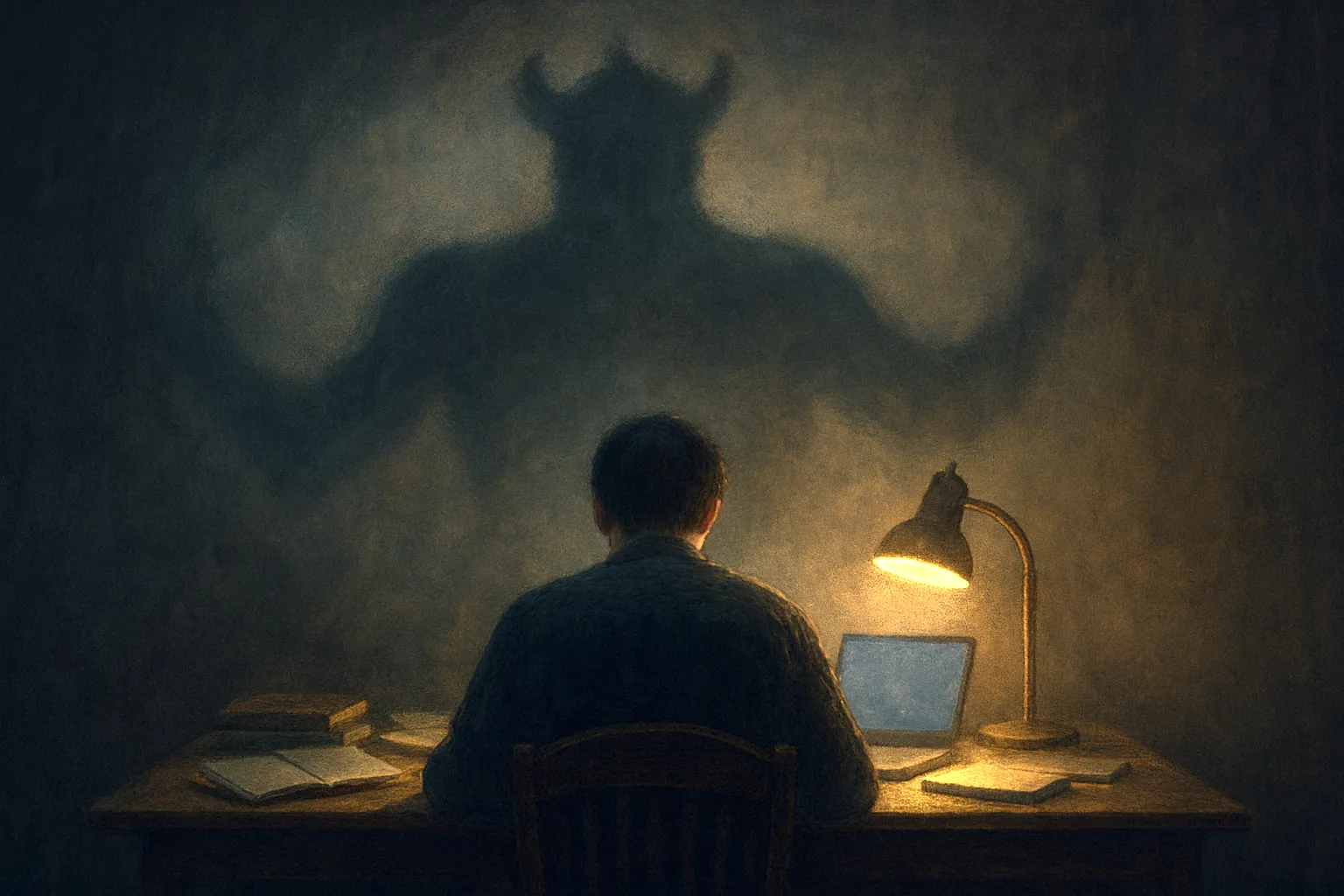
I suspect that for many readers this text will sound like an exercise in sophistry. I am undecided myself. When someone has spent so many years watching the world almost exclusively through screens and texts, through other people’s minds and other people’s disasters, something inside them begins to shift. Gradually, almost imperceptibly, they realize they are turning into a strange hybrid: part accountant of the universe, part wooden idol of a third-rate god. They wield no power over anything, yet by some perverse logic they are expected to know everything, and that knowledge alone drains them in ways they could never have imagined at thirty.
I am tired. I am without hope. And yes, in a dangerously ironic sense, I am God. Not one of the real ones, of course, but a kind of micro-god: an inconspicuous deity arranging words in the basements of culture while above, under the open sky, drones circle, flags burn, and someone takes yet another selfie. This is godliness without omnipotence. A godliness reduced to nothing more than presence, observation, and knowledge.
For a long time I believed that what we call chance could be measured in the right encounters, the right publishers, the occasional “key” text that redirects a life. Slowly, almost without noticing, I began to understand that chance is not an event but a role. Not an outcome, but a position within a larger stage set, one you either inherit or do not. Mine turned out to be off to the side, slightly in the corner, where the handle of an eternally humming machine is cranked — a machine others like to call a magazine, a platform, or a project. For me it has long since become nothing more than a habit. A habit of checking what the world has said. A habit of filtering. A habit of telling myself: this will never work in Bulgaria, but I will publish it anyway, if only to avoid falling completely ill from meaninglessness.
And so, little by little, I reached the point at which someone who officially “works in culture” begins to doubt the very idea of a cultural chance. Not dramatically, not hysterically, but with that quiet, persistent fatigue that arrives the moment you stop believing you will ever fall in love again, or that someone might yet discover in you a belated talent for the violin. You simply stop seeing it. Not in this life.
At the same time, there is a paradox I cannot ignore or digest. I have never known so much. I do not mean facts — those migrated to my phone long ago — but a constant, almost breathless state of awareness, accumulated through years spent standing at the entrance to the world. Almost every war, every political crisis, every new moral panic, every invented “unprecedented” historical analogy passes through my head on a daily basis. I do not think this makes me particularly important or significant. It is simply the occupation I chose for myself. The one on duty at the door. The night watchman.
But when you stand at such a door for long enough, strange symptoms inevitably appear. First, you stop being impressed. Then you begin to feel ashamed that you are no longer impressed. At the third stage, you learn to simulate the appropriate degree of engagement society expects from you, just to avoid being accused of cynicism or emotional deficiency. Internally, however, you crossed the threshold long ago, beyond which there are only two possible paths. Either you lose your mind, or you begin to see the world as an absurd work of art — something no one ever intended to create, yet which, by some cosmic inevitability, all of us are forced to keep shaping. I would not claim to have chosen the latter consciously. I suspect it is simply an instinctive reflex of self-preservation: the only option that still offers some chance of preserving what remains of my sanity.
Not every god is a creator, of course. There are also observer gods — gods not as architects of worlds, but as witnesses without the right to intervene. That seems to be the role assigned to me. I search, I read, I translate, I arrange. And more and more often I discover that the knowledge I accumulate leads nowhere a person of sound mind would envy. It offers no power, peace, or recognition. All it does is painfully sharpen my awareness of my own helplessness. To know too much and to be able to change absolutely nothing is a peculiar form of martyrdom, stripped of grandeur and faith.
It is the martyrdom of someone who knows that his texts articulate things that may one day prove correct, yet today will change neither a parliament nor a street nor even the attention of the person skimming them on a phone while waiting for the light to turn green. I might be tempted to say they cannot change the author either, but that would be dishonest. They do change me. They simply do so in ways that are neither beautiful nor ennobling.
Many years ago I believed that at least books would remain. That literature was some kind of shelter, a bunker, a place to hide from the chaos of history. Today I am no longer certain I even believe that. Not because books have deteriorated — far from it. Remarkably intelligent, brave, complex books are still being written. What has eroded, almost without my noticing, is my capacity to enter them, to surrender to their internal logic. Not physically — I read when I translate — but existentially. Books ceased long ago to occupy my life in the way they once did.
Today they are more a memory of a habit than a living necessity. I rarely have enough air for a single sustained narrative when thousands of others pound on my door every day, demanding processing, translation, arrangement. Somewhere along the way I stopped being a reader and became an operator. An operator of meaning. A technical functionary in a vast transmission station for ideas. And once you reach that point, fatigue is no longer a pose you wear like a medal. It becomes heavy, coarse, and physical — the exhaustion of someone who knows he will do the same thing again tomorrow. Not because he loves it that much, but because there is nothing else he can do, and because stopping would mean falling apart.
People sometimes ask me why I continue. The truth is simpler than I would like to admit. I enjoy seeing the world from above. Not in a moral sense, as judgment, but structurally, as observation. I like watching themes interlace, stories repeat, slogans that sound monumental today get discarded as useless tomorrow.
I like recognizing the same arguments articulated in new language. Watching societies cycle through indignation, guilt, pathos, and oblivion. It is a particular kind of pleasure — not divine, but quiet — and impossible to share. How do you explain to someone living through what feels like a personal moral or political catastrophe that you see it merely as another variation on a familiar motif? Say it openly and you sound like a cynic. Remain silent and you are left with the sense that you lacked the courage to be honest.
The only thing left, then, is writing. Writing in a way that leaves enough oxygen in a single sentence for your skepticism, someone else’s hope, and our collective stupidity to coexist. And hoping that someone, somewhere, will sense that beneath the surface pessimism lies not surrender, but a stubborn resolve to persist.
“I have no real chance” is a sentence that has been looping in my head like an advertising jingle. No chance of what, exactly? International fame? Major stages? Books traveling the world? At sixty-something, such ambitions are not merely ridiculous; they border on indecency. And yet there is another kind of chance I am still unwilling to abandon.
The chance that some future reader might stumble upon one of the texts I leave behind and think, not “how clever the author is,” but “this is what I felt, but could not put into words.” This is the only form of godliness I acknowledge. Not the creation of worlds, but the recognition of someone else’s loneliness and its conversion into a sentence.
And here I return to the beginning. I am tired. I am hopeless, if the standards are those of my youth — recognition, canonization, print runs, translations. Yet, strangely, I have never seen myself more clearly. I am someone who spent his life working with texts and came to understand, painfully, that the reward lies not in the sweets at the end, but in the act of turning the crank itself.
I hope I am not writing this in search of consolation. For me, consolation is a belated and humiliating category. I write to leave a protocol of a condition. This is what a tired, slightly embittered, sometimes faintly ridiculous, yet still stubbornly faithful to words person looks like, stranded on the periphery of a culture that no longer knows what to do with itself.
If there is anything divine in this story, it is simply that I have not stopped. Not in anticipation of a grand finale, but because it feels indecent to leave the stage while the world continues so industriously to disgrace itself.
Perhaps in another life I will find a better explanation. In this one, I will continue to observe the world, to open texts, to arrange other people’s sentences and my own. Tired, with little hope, yet in a strange way exactly where I am supposed to be.
