
01 Sep, 2026


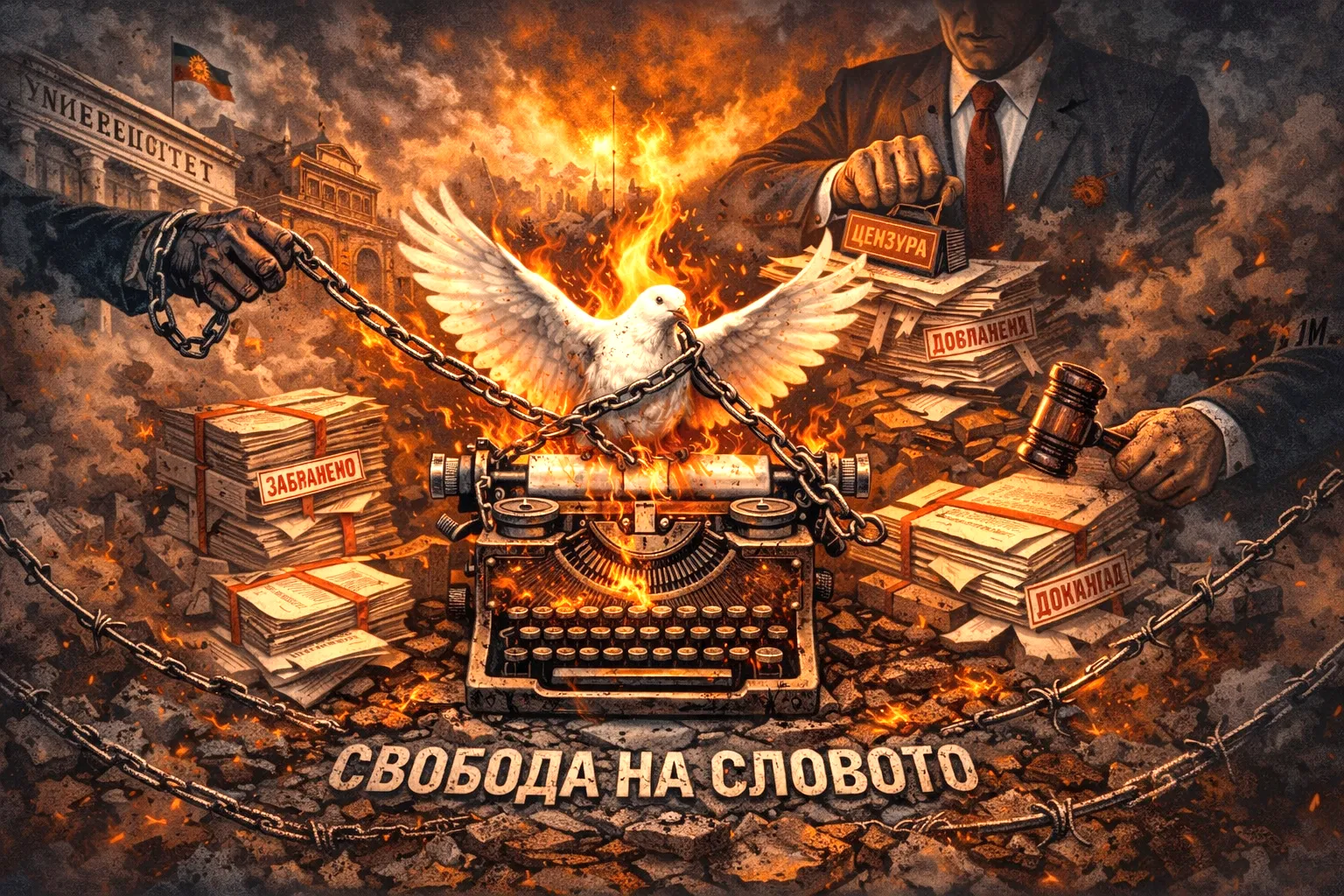
I am writing this as someone who looks at his country from the outside and, with growing alarm, realizes that it is being quietly pushed beyond the boundaries of any acceptable standards of democratic life, academic independence, and freedom of speech. This is not about a single event, nor about a single institution, nor about the latest “storm in a teacup.” It is about a method – an entire repertoire of actions that turn dissent into something institutionally impossible, without ever formally prohibiting it. That is precisely what makes what has happened all the more disturbing: everything looks legal, managerial, “responsible.” And yet the result is the same – the draining of meaning from freedom until it remains only an empty word in the rulebooks.
The case at Sofia University, which unfolded between April 2024 and December 2025, is not an exception. It is a symptom. In it I see, in concentrated form, everything that has happened repeatedly in Bulgaria – under different regimes, with different ideologies, but according to the same logic: when free thinking becomes a risk, institutions do not defend it; they readjust themselves so that the risk disappears together with the possibility of conflict.
In the spring of 2024, a public event was scheduled at the university’s Cultural Center as part of an officially approved semester program. Nothing hidden, nothing illegitimate. An academic discussion on a controversial historical issue – exactly the kind of conversation for which universities exist. But even before it could take place, the event was publicly denounced from the outside as “anti-Bulgarian.” And here the fragility of institutional courage became visible. Instead of clearly defending the right to pluralism, the rector publicly distanced himself from the event, even though it was part of a program approved by himself. This act of distancing was decisive. Not because it prohibited anything, but because it sent a signal. It told everyone: there is no cover here anymore. From that moment on, every attack was legitimized.
The postponement of the event did not calm the situation – on the contrary, it escalated it. A political figure used the floor of the National Assembly to attack not only the topic, but the very right for such a discussion to be conceived and held. The Cultural Center and its leadership became the target. And the next day came the statement that, for me, marks the full moral collapse of the Bulgarian academic body, spoken by one of its leading representatives: the rector of Sofia University declared to a media outlet that had already branded the event as “anti-Bulgarian” that the university was obliged to defend the official state position on historical issues.
Can you imagine what the reaction would be if such a statement were made in any civilized country in the world: that the task of universities is to serve as mouthpieces of the state? Shame, scandal, total disgrace. And most importantly: from the academic community and from society at large there followed not a sound. No protests, no clarification of the basic task of universities to serve as centers of independent thinking and disagreement with state policy, nothing at all. How long do you think the Vietnam War would have lasted if similar views about academic freedom had prevailed there?
Let us not deceive ourselves with nonsense and sentimentality. This was not a mistake. It was total capitulation dressed in a rector’s gown. A renunciation of the very idea of the university in the name of “state responsibility.” And immediately afterward – the obligatory, obsequious promise of “institutional measures” and “reform.”
From that moment on, the real operation began. Not loud, not brutal. Simply pedantic, carried out in the well-known spirit of Andrey Lyapchev’s old formula: “With gentleness, with kindness, and with a little bit of force.” Committees were created without the knowledge of the teams that would be affected. Draft regulations appeared suddenly, submitted at the last minute, with no real opportunity for debate. Every attempt at technical correction was rejected without argument. The idea was simple: not to improve governance, but to remove initiative. The professional team was displaced by an abstract managerial body, lacking both expertise and – as it turned out – real functionality. Paralysis became method. Delay was used as a familiar instrument. Improvisation turned into a norm.
I need to be clear: this is not administrative incompetence, but a deliberate strategy. When a body essential for the normal functioning of an important cultural institution is not constituted for months; when the regulations exist but never reach those who must apply them; when procedures contradict one another internally and still come into force – this is not chaos. It is something else entirely: discipline through uncertainty.
The finale was just as telling. A competition for a new director was announced quietly, without consultation and under conditions that sharply narrowed the circle of eligible candidates. The people who had built the institution were excluded from the process. The selected candidate was part of the committee that had written the new regulations. There was no discussion of vision, no continuity, no accountability. And finally – the inevitable resignation of the sitting director. Not as a gesture, but as the logical end of a system in which professional autonomy had become incompatible with functioning.

What frightens me is not only the Bulgarian repetitiveness of this pattern. What is frightening is how neatly it fits into a broader European scenario. In Hungary, this path was taken earlier and faster: universities were “reformed,” their autonomy formally preserved but effectively placed under control; critical institutions were restructured; inconvenient ones pushed aside. There the process already has a name and an international reputation. In Bulgaria, it is still masked as a series of isolated incidents, as “tension,” as “bad timing.” But that is, of course, an illusion. The logic is the same, only the pace is slower and the language more moderate. As anyone with independent judgment can see, Bulgaria is quietly submitting an application to join what might be called the “Anti-Liberal International” – as usual, at the back of the queue, but fully ready for admission, if with its paws raised in a charming gesture of demonstrative innocence. “Who, me? Surely not!”
The historical precedents in Bulgaria are painfully clear. Since the end of the nineteenth century, intellectual dissent here has almost always been perceived as a threat rather than as a resource. Different regimes have used different means – from bullets to camps, from bans to “reorganizations.” What they all share is a refusal to defend the space of argument itself. Today there is no need for repression. Regulations, committees, and managerial rhetoric are enough.
That is why this case must not be allowed to sink into oblivion. It shows not how freedom of speech is banned, but how it is made unnecessary. How initiatives begin to seem “inappropriate” even in the minds of those who might propose them. How fear becomes internalized, and censorship turns into self-limitation.
As an outside observer – and as someone for whom this country still means something – I refuse to accept this as normal. I refuse to accept that a public academic institution can renounce its autonomy at the first serious political pressure without consequences. I refuse to accept that society should see this as a “reasonable compromise.” Because every such compromise narrows, just a little more, the space in which democracy still makes sense.
If this model remains unnamed and unchallenged, it will reproduce itself again and again. Quietly. Legally. Predictably. And then we will no longer need bans. We will simply have grown so used to them that, once again, we will most likely fail to notice that we ourselves are the ones who have enacted them.
