

20 Sep, 2026


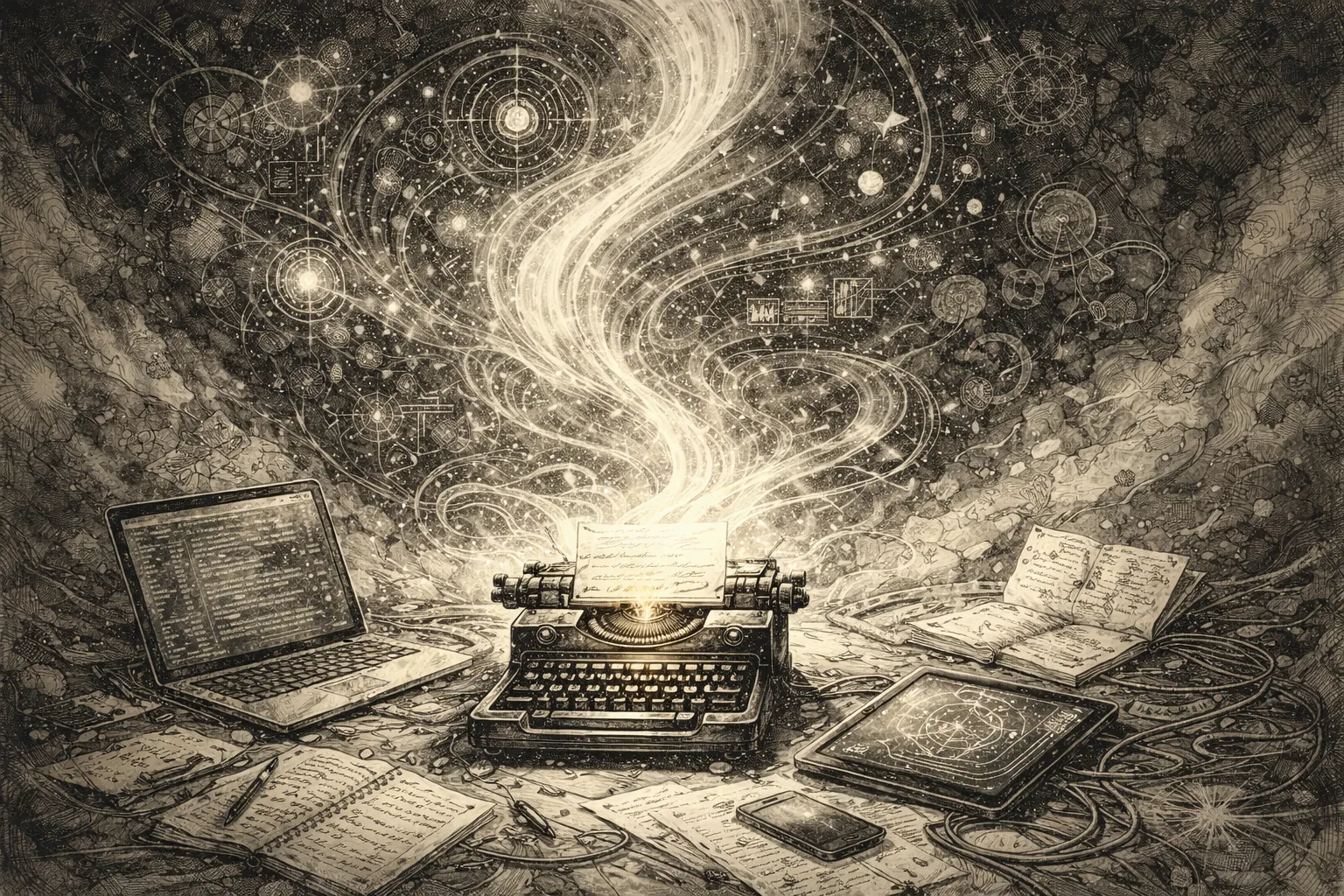
At twenty-nine I burned everything I had written. Not symbolically or as a gesture meant to dramatize a turning point, but quite literally, with the cold determination of someone who believes he has finally understood the limits of his own nature. Years of fragments, drafts, beginnings, abandoned manuscripts, notebooks filled with restless attempts at shaping something that never quite held together — all of it went. The decision did not feel tragic at the time. It felt logical. I had come to the conclusion that writing, at least in any sustained and serious form, was structurally impossible for me.
The problem was not a lack of ideas. If anything, the opposite was true. My mind had always worked in a way that produced too much material at once, too many impulses colliding, too many directions opening at the same moment. A sentence written in the morning would already feel provisional by noon, not because it was wrong, but because new thoughts kept pressing in, demanding correction, expansion, reordering. On paper, this turned into a very specific kind of physical chaos. Every page became a battlefield of crossings-out, insertions, arrows, marginal notes squeezed between lines, whole passages rewritten on top of earlier corrections until the text itself began to dissolve into an almost unreadable maze. I would try to copy things cleanly, hoping that a new version would stabilize the material. Instead, the same process would begin again immediately. New impulses would arrive, new changes would seem necessary, and the clean page would soon look like the old one.
At some point I realized that I could not keep up with my own revisions. Writing required a kind of continuity, a kind of sustained patience with form, that I simply did not possess. I could generate beginnings endlessly. I could not bring them to rest. The friction of the medium itself — the fact that every correction left a trace, every change damaged the surface, every attempt at improvement made the page more chaotic — became unbearable. The gap between what I sensed internally and what I could physically produce grew so wide that it began to feel humiliating. Eventually, the simplest explanation seemed the most honest one: I was not built for this. The act of burning the manuscripts was less a surrender than a practical closing of a door. I made a solemn promise to myself that I would never try to write seriously again, convinced that I had reached a real, structural limit.
For nearly a decade, that decision held. Writing receded into the background, into something I no longer expected of myself. Then, without ceremony, something entered my life that I did not at first recognize as a turning point. I began to use a computer. What struck me was not the novelty, not the speed, not the modernity of the thing, but something far simpler and far more decisive: the page stopped resisting me. A sentence could be rewritten without leaving scars. A paragraph could be moved, expanded, reduced, reshaped without turning the whole text into a ruin. Corrections no longer accumulated as damage. They disappeared. The surface remained clean, no matter how many times I interfered with it.
The effect was immediate and profound. The same internal mechanism was still there — the same restlessness, the same flood of revisions, the same inability to leave anything alone — but it no longer destroyed the work as it formed. The medium had changed, and with it, the entire experience of writing. What had once felt like a personal failure suddenly revealed itself as something else: a problem of friction. My mind had not become more orderly. I had not become more disciplined. Nothing essential about the chaos had changed. What had changed was the tool’s ability to absorb that chaos without collapsing under it.
Looking back, this was the first time in my life that a technological shift quietly intervened between an internal handicap and its consequences. At the time, I did not think of it in those terms. I only felt an immense sense of relief, as if some invisible assistant had stepped in to hold the text steady while I continued to interfere with it. The chaotic impulses remained exactly what they had always been, but now they could be followed, rearranged, refined, without destroying the very thing they were trying to shape. Writing returned not as a heroic decision, not as a rediscovered vocation, but as a simple practical possibility. For the first time, I could allow the disorder to exist and still move forward.
If the word processor was the first quiet intervention that allowed writing to return, the next came from a completely different direction, and in a sphere where, by all appearances, I had even less reason to expect anything from myself. I had always possessed a certain kind of visual thinking. I could sense how things should look, how ideas might be condensed into shapes, how a structure could be made visible at a glance. Yet I had none of the abilities that normally accompany such intuitions. I could not draw. I could not paint. My hand refused to follow what my mind suggested. Every attempt at putting something visual on paper ended in the same frustration I had once experienced with writing: a gap between the internal image and the external result that seemed impossible to close.
Under older conditions, this would simply have meant that the talent, if it existed at all, would remain unused. Conceptual imagination without manual skill does not produce visible work. It remains locked inside. But here again, technology entered not as an improvement but as a bridge. Graphic software, layout programs, the growing precision and flexibility of digital tools made it possible to think visually without having to execute everything by hand. One could move elements, test variations, try combinations, undo, begin again. The process was no longer bound to the immediate adequacy of the hand. It became fluid, reversible, exploratory in the same way writing had suddenly become fluid once the text left the paper.
What surprised me most was not that I learned to use these tools, but that they revealed something I had not known about myself. I began to discover that I had a real sense for presenting ideas visually, especially in the field of conceptual design: covers, layouts, logos, structures in which a thought could be condensed into a single image. The skill was not in producing the image from scratch, but in recognizing when a form captured the essence of an idea. Once again, the internal mechanism was messy and indirect. I would try one variation, then another, move things around endlessly, test combinations, discard, return. The same restlessness that had once made writing almost impossible now became a resource. Because everything could be changed without damage, the process of searching did not destroy the work. It refined it.

An entire professional life began to grow out of this. I found myself working in book design, in visual presentation, in a field that, at first glance, should have been completely closed to someone who could not draw. Looking back, the paradox still feels striking. The only artistic domain in which I had no natural manual intuition became the one in which I built a career. Yet the explanation is not mysterious. The tools removed the barrier that had once made the difference between having an idea and being able to realize it. They allowed me to operate at the level where I was strongest: the conceptual one.
This was the second time the same pattern repeated itself. A specific handicap — in this case, the inability to translate visual intuitions into physical form — might once have been decisive. Under the new conditions, it lost its power. The computer did not give me talent. It made a certain kind of talent usable. The work remained chaotic. I would try too many versions, change directions, lose time in details that might not matter. But the medium tolerated this. It absorbed the disorder and kept the process alive.
By then, a quiet suspicion had begun to form, though I would only recognize it much later. Perhaps the internal chaos I carried was not, by itself, the whole story. Perhaps what had once seemed like an absolute personal limitation had always been tied to the resistance of the tools available at the time. Each time that resistance was reduced, something that had seemed closed opened again. Writing returned once the page stopped punishing corrections. Visual thinking became a profession once the hand was no longer the only instrument. In both cases, the change had not come from inside me. It had come from the outside, from technologies that made it possible to keep interfering without destroying what was being formed.
The next shift did not concern a single tool but an entire environment. By the time the Internet became a daily presence, another limitation had already made itself clear in my life, one that was far less technical and far more difficult to overcome. I was never well suited to working in teams. Not because of hostility or unwillingness, but because of a certain internal rhythm that never aligned easily with institutional life. Long-term coordination, shared planning, stable collective projects — all of this required a kind of continuity and predictability I could not reliably maintain. I would enter such structures with enthusiasm, contribute intensely for a time, then drift, lose focus, move elsewhere, or become absorbed by something else entirely. From the outside, this could look like inconsistency or lack of discipline. From the inside, it felt more like a system that ran in bursts rather than in steady lines.
In an earlier era, that would have been a decisive handicap for anyone who wanted to produce intellectual work with a public presence. Publishing required networks. Editorial work required institutions. Visibility depended on belonging to structures that could sustain attention over time. A person who could not integrate into these rhythms would simply remain at the margins, no matter how much material he might generate on his own. Solitary work existed, of course, but it had no stable channel through which to circulate.
The Internet altered that landscape completely, and with it, the practical meaning of solitude. For the first time, it became possible to build something that functioned publicly without requiring a team to keep it alive. A magazine could exist without an office. Texts could be published without a publisher. A continuous stream of writing could find readers without passing through the traditional gatekeeping mechanisms. What had once been a structural weakness — the inability to sustain collective work over long periods — began to turn into a different kind of working method.
This is how my own magazine was born. It was not the result of a long-term plan, nor the expression of a coherent strategy. It emerged gradually, through the accumulation of pieces, translations, essays, reflections, arguments. What made it possible was not discipline in the usual sense but the simple fact that the technological infrastructure could absorb irregularity. I could produce in bursts. I could leave the project unattended for a time, then return with intensity. The platform remained. The archive grew. The work did not vanish when attention shifted elsewhere.
For someone who functions in cycles rather than in lines, this mattered enormously. The Internet created a kind of external memory and continuity that I could not always provide myself. The magazine could expand, evolve, and gather material over years, even when my own internal rhythms fluctuated. Volume began to play a role. Even when individual efforts were interrupted or abandoned, the sheer accumulation of work created a presence that would not have been possible under earlier conditions.
Recognition, if it came at all, came in fragments. There was no single breakthrough moment. No institutional endorsement that suddenly changed everything. But the work existed in the open, visible to anyone who cared to look. That alone would have been unthinkable in a pre-digital world. A solitary endeavor, sustained over years by one person’s irregular energy, could now function as a small cultural organism of its own.
At the same time, the old pattern did not disappear. The same chaos that allowed for sudden periods of intense production also made it difficult to pursue visibility in a consistent way. Paths that might have led to broader recognition were often left half-followed. Promising openings were sometimes abandoned at the moment they required steady pressure. From the outside, this could easily be interpreted as self-sabotage. From the inside, it was simply the same internal mechanism asserting itself again. The Internet made it possible to build without a team. It did not change the way the engine itself ran.
Still, something important had shifted. For the third time, a technological environment had compensated for a structural limitation. The inability to work within stable collective systems no longer meant silence. Solitary work could circulate. The distance between production and publication had narrowed. The same chaotic energy that once dissipated without leaving a trace could now accumulate in visible form. The system remained irregular, wasteful, unpredictable. But it no longer collapsed under its own weight.
By this point, the pattern was clear enough, even if I did not yet fully understand it. At several decisive moments in my life, a specific limitation had threatened to close a path entirely. Each time, a new technological layer had appeared that did not remove the limitation but reduced its consequences. Writing became possible once the page stopped punishing correction. Visual thinking became usable once the hand was no longer the only instrument. Solitary work became sustainable once publication no longer depended on belonging to a structure. What had once felt like fixed personal deficits were gradually absorbed by an environment that made them less decisive.
And yet the other side of the picture remained unchanged. The same internal mechanism that made these interventions necessary also continued to shape everything I did. It was never simply a story of obstacles overcome. The chaos was not an external enemy. It was the engine itself. It generated the ideas, the impulses, the sudden intensities without which nothing would have been written or built. But it also scattered effort, disrupted continuity, and repeatedly undermined consolidation just at the moment when stability might have begun to form.
Looking back over the years, I can see how often I came close to something that might have become a more visible position, only to turn away from it without fully understanding why. Opportunities appeared, contacts formed, projects began to gather momentum — and then, at some point, the energy shifted. Attention moved elsewhere. New lines of thought opened. The previous direction, which might have required steady, sustained pressure to turn into something durable, lost its urgency. From the outside, this must often have looked like carelessness or even self-sabotage. From the inside, it felt less dramatic and far more ordinary. The system simply moved on.
This is where the double edge becomes visible. The very restlessness that produces work also makes it difficult to hold on to the paths through which that work might become more widely known. The same impulse that insists on constant revision and exploration resists the repetition and patience required for consolidation. The technologies that made production possible did not change this basic dynamic. They made it easier to create, to publish, to experiment, to start again. But they also made it easier to abandon things halfway, to disperse attention across too many directions, to let promising threads fade as new ones appeared.
In this sense, the crutches that supported the work also quietly reinforced the conditions under which it could remain fragmented. The word processor made revision fluid, but it also made endless revision tempting. Design tools made experimentation easy, but they also multiplied the number of possible variations. The Internet made solitary publication possible, but it also made it possible to begin new projects at any moment, without the resistance that might have forced a decision. Each technological shift reduced friction, and in doing so, it allowed the chaotic engine to run more freely in every direction at once.
Recognition, in such a system, becomes an uncertain by-product. It requires continuity, repetition, visibility sustained over time. A chaotic mode of production does not easily align with these rhythms. It produces surges, not campaigns. It builds archives, not trajectories. Over the years, I often found myself aware of this tension in quiet moments. I could see the almost-achieved positions, the points where a more consistent effort might have turned a body of work into a clearer public presence. The awareness did not necessarily lead to change. The mechanism that produced the work was the same one that resisted the discipline required to stabilize its effects.
And yet, despite all the dispersion, something continued to accumulate. Texts gathered. Ideas returned in new forms. Earlier attempts fed later ones. Even when individual paths were abandoned, the material did not vanish entirely. It settled into an expanding archive that bore witness to the irregular rhythm of the engine that had produced it. The technologies that supported this process did not impose order. They did something more modest and perhaps more important. They made it possible for disorder to leave a trace.
Seen from close up, the story so far might appear purely personal: one life shaped by a sequence of tools that happened to arrive at the right moment, each time reducing a particular friction, each time making it possible to continue. But distance changes the perspective. When I look back now, the pattern no longer seems accidental. It begins to resemble something broader, something that goes beyond the biography of a single individual and touches on a quieter, more general question: how many kinds of minds were historically able to produce anything that survived them, and how many simply dissolved, not for lack of ability, but because the conditions required to stabilize their work did not exist?
For most of human history, intellectual production depended on a very narrow set of temperaments. To write meant to endure a slow, linear process. To revise meant to rewrite entire passages by hand. To publish meant to enter a structure, to negotiate with editors, to belong somewhere. To sustain a body of work meant to maintain continuity over years, sometimes decades. These conditions did not only select for talent. They selected for a certain kind of internal order. People who could hold a line, who could return to the same material again and again without losing direction, who could build patiently, who could submit to structures, who could tolerate the friction of slow correction and delayed result. Other types of minds, equally intense, equally fertile, but less stable, less continuous, more easily scattered, were at a structural disadvantage from the beginning.
This does not mean they did not exist. They certainly did. One can imagine how many unfinished manuscripts, abandoned projects, broken attempts must have accumulated in the lives of people whose inner mechanisms resembled mine in some way. Without tools that could absorb constant revision, without environments that could tolerate irregular bursts of production, without channels that allowed solitary work to circulate, much of what they might have produced would have remained fragmentary or invisible. Their ideas would have existed, perhaps vividly, but without a medium capable of holding them long enough for them to take form. History, as we know it, would then be shaped not only by the strongest minds, but by the most stable ones.
From this perspective, the arrival of certain technologies begins to look less like a series of conveniences and more like a slow expansion of what kinds of intelligence can actually leave a trace. The word processor did not only make writing faster. It made revision tolerable for people who could not leave anything alone. Digital design tools did not only simplify visual production. They allowed conceptual thinkers without manual skill to operate in a visual medium. The Internet did not only accelerate communication. It created a space in which solitary, irregular, unsynchronized production could accumulate into something visible over time. Each shift quietly widened the range of temperaments that could participate in public intellectual life.
This is not a grand, dramatic transformation. It happens without proclamations. There is no moment at which one can say: from now on, chaotic minds are welcome. And yet, something changes. The threshold at which internal disorder becomes fatal rises. What once would have led to abandonment can now be absorbed. What once would have remained a private struggle can now leave an archive behind it. The history of thought begins, very slowly, to include types of production that were previously filtered out by the material resistance of the tools themselves.
At this point, the story of my own life returns in a different light. The repeated pattern I experienced — a limitation encountered, a path closed, a new tool appearing that reopened it — no longer seems purely accidental. It begins to look like a small, individual instance of a larger shift. Not a heroic story, not an exceptional one, but a case study of what happens when a particular temperament meets an environment that gradually becomes more tolerant of its internal structure. The chaos did not disappear. The instability did not resolve into order. But the world around it changed in ways that made it possible for the work to continue despite that.
The most striking thing, perhaps, is how quiet this process is. There is no sense of a revolution. No one announces that a new type of mind has entered the field. And yet, if one looks carefully, the landscape begins to fill with people working in irregular rhythms, producing in bursts, moving across disciplines, building bodies of work outside the old institutional pathways. Not all of it is good. Much of it is scattered, uneven, unfinished. But it exists. It leaves traces. It accumulates. And in that accumulation, something shifts. What counts as a viable intellectual life begins, slowly, to expand.
If the earlier shifts altered the tools through which work could be stabilized, the present moment feels different in a more intimate way. For the first time, the prosthesis no longer stands outside the process. It no longer merely holds the page steady, organizes the image, or keeps a platform open. It begins to touch the act of thinking itself. Ideas that once remained vague or fleeting can now be caught, shaped, extended in conversation, held long enough to become visible. The distance between impulse and form shortens again, but this time not through mechanical convenience alone. Something enters the space where disorder and structure meet.
For someone whose mind has always functioned through interference, through competing impulses and sudden shifts of direction, this change is difficult to overstate. Much of what I have produced over the years emerged from a kind of pressure: fragments gathering, colliding, slowly forming a line strong enough to follow. But just as often, ideas remained suspended in a state that was too diffuse to be developed. They existed as feelings of direction rather than as arguments, as shapes sensed in the distance but never quite reached. Earlier technologies helped once the material had begun to take form. They made writing, designing, publishing possible. They did not help much at the moment when the thought itself was still unstable.
Now, something different happens. A vague intuition can be spoken, returned to, refined, extended. A half-formed idea does not have to remain internal until it is fully clear. It can be tested in motion. For the first time, the chaos at the very beginning of the process — the moment when everything is still fluid and uncertain — finds a kind of external support. Not a replacement for thinking, but a structure that can hold the thread while the mind moves, loses it, returns, begins again.
This does not remove the old pattern. The restlessness remains. The dispersal remains. The tendency to move in bursts, to abandon, to start anew does not disappear. If anything, the ease of beginning again becomes even greater. But something else changes as well. The threshold at which an idea can be stabilized lowers once more. The distance between having a thought and seeing it take shape shortens. For a system that has always depended on friction being reduced in order to function, this feels like another quiet intervention, as decisive in its own way as the first encounter with a word processor once was.
I am aware, of course, that there is a temptation to turn this into a story about salvation, about technology carrying the individual mind forward beyond its natural limits. That is not how I experience it. The work still depends on the same irregular energies, the same sudden intensities, the same periods of darkness and return. Nothing fundamental about the internal mechanism has changed. What has changed, again, is the environment in which it operates. Each time the tools become more fluid, more tolerant, more capable of absorbing instability, the space in which a chaotic system can remain productive grows a little wider.
This has a particular meaning when one begins to think about time in a more concrete way. Energy fluctuates. Concentration changes. The body, sooner or later, begins to send its own signals. Under older conditions, a mind that depended on bursts of intensity might simply have exhausted itself. The effort required to hold everything together would have become too great. But if the surrounding structure continues to reduce the friction at each stage — from writing, to designing, to publishing, and now even to the early shaping of thought — the possibility opens that productivity might not decline in the same way it once did. Not because the mind becomes stronger, but because it is held more gently by the tools around it.
Seen from this angle, the story that began with the burning of manuscripts at twenty-nine comes full circle. What once seemed like a personal failure now appears as the starting point of a long series of adjustments between an internal chaos and an external world slowly learning how to accommodate it. Each technological layer functioned as a kind of crutch, not replacing the engine but allowing it to run without destroying itself. Writing became possible. Visual thinking became visible. Solitary work found a public space. And now, even the earliest, most uncertain movements of thought can be given form before they fade.
Perhaps that is all one can say in the end. Some minds are not built to burn steadily. They flare, subside, gather force, disperse again. Under the wrong conditions, they leave little behind them. Under the right ones, they begin, slowly and almost by accident, to accumulate. Technology does not change what they are. It clears space around them, again and again, just enough for the next burst of light to take shape and remain.
