

29 Oct, 2026


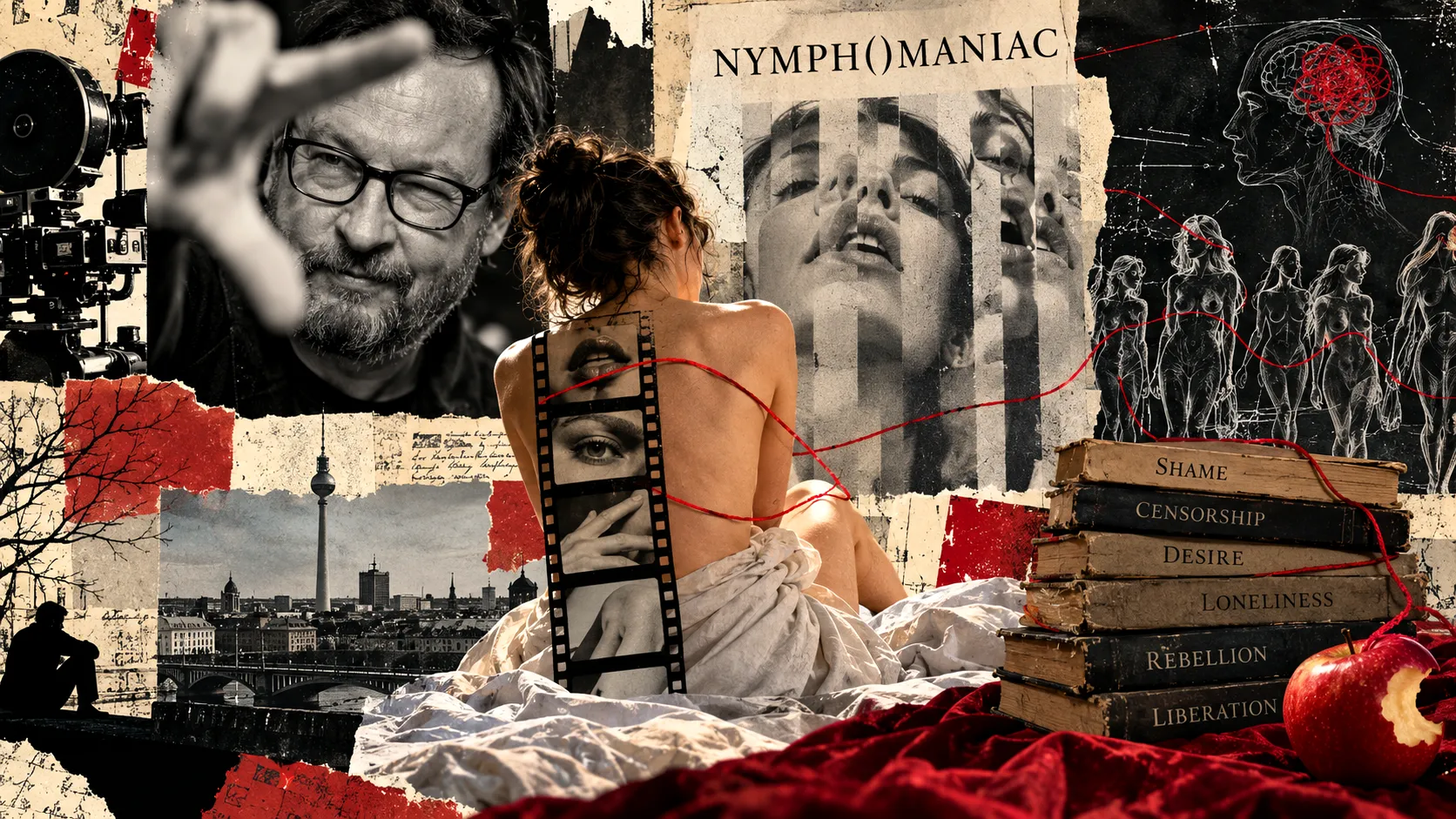
A series of random thoughts prompted by watching Lars von Trier’s “Nymphomaniac”…
What is your own definition of art? Don’t feel intimidated; we’re not talking about some kind of highfalutin scholarship here. I’m asking something very simple: how do you recognize that something created by a human being is genuine?[1]
My own answer: art is something that makes me lose control of myself.[2] Usually not for long, and for quite some time now – not nearly as intensely as it once did – but with undiminished force nonetheless. It might be an almost unbearable rush of goosebumps; it might be an inability to tear my eyes away from a scene that otherwise fills me with genuine revulsion, almost beyond endurance; but most often, it’s simply tears.[3] Uncontrollable empathy, an inability to suppress the (essentially stress-induced) reaction that comes from experiencing someone else’s (professed) emotions as though they were your own.
So far, fairly banal. Things become a little more interesting when I start adding my further, considerably more controversial criteria. Serious art begins where there is also an unmistakable sense of liberation, of deliverance from some burden, or at least a sincere attempt to achieve it. As you may already have guessed, this puts the question of the actual impact of real art into perspective: the simple fact that profound things rarely touch us quickly, let alone “change” us. Great music is rarely the kind we find ourselves humming after hearing it once or twice.[4] The same, I suppose, applies to most of the other “great” things each of us carries within. And this, too, is self-evident, simply the way things “ought” to be: deliverance could hardly be genuine if it came easily.[5]
Hence my next criterion, which may simply be a variation on the previous one: serious art, as I experience it, is inseparably bound up with rebellion. Nothing against Baroque playfulness or the (supposed) divine serenity of Classicism. Nothing even against the moral strength claimed by the various “educational” schools.[6] But that is not my world. To me, art without rebellion is a contradiction in terms, pure and simple, an attempt to strip away the very quality that separates living matter from dead matter.
Which brings me to the real reason for writing this piece: Lars von Trier’s Nymphomaniac – Part I, which I’ve just watched. As I already mentioned on Facebook, the feeling is a little like being hit by a neutron bomb: there’s no explosion to speak of, only the devastation is very much in evidence… Good old Lars continues his (brilliant) crusade against the various torments inflicted by the forms of censorship human beings impose upon themselves and one another. And that’s good, that’s wonderful, for all of us. At least I myself always leave his films with a thoroughly palpable sense of relief, if only because of the selfish satisfaction of knowing that I’m not the only lunatic in this world who has apparently chosen to torment himself over, and speak publicly about, things most of us prefer to keep quiet about. Of course, that doesn’t mean there’s any deeper resemblance between us beyond the basic irritants we share: (sexual?) (dissatisfaction?) and an acutely felt need for compensation, preferably in forms that might stand some chance of resembling “art.” The rest, if you’ll allow me the expression, is a matter of “sing on, sorrowful heart”: feeling trapped, we’ve chosen to sing instead of weep. The relief, needless to say, is highly questionable in either case.
And so, the subject here is nymphomania. Or rather, not simply nymphomania, but nymphomania as a highly concentrated essence of the human inability to experience genuine closeness, communion, and shared feeling. Loneliness. And not just loneliness, but that unbearably searing variety of it which condemns you to solitude even during the most intimate human act imaginable, one that requires (at least) two people. Lars’s genius, both visual and verbal, has taken shape here in the astonishing form of what, with a certain frivolity, I’ll venture to call a “recipe for cooking parrot.” The point is this: parrot meat, as everyone knows, is too tough to eat, however long you boil it. But that’s only in the real world. In Lars von Trier’s universe, by contrast, this very parrot meat, the fundamentally unshareable reality of nymphomaniac existence, has been transformed into a dish that is not merely edible but positively delicious, even addictive, something from which one (or at least the particular person I happen to be) can tear oneself away only with difficulty, through a genuine effort of will, and only after realizing that the cinema is gradually emptying, which means that “good night, children” is over, it’s time for everyone to go back to their own lonely, terribly dark nursery, the end, full stop, that’s all there is.
Of course, all this comes at a price. A certain sense that the story is constructed, fabricated, contrived never quite leaves you. And even Lars himself, in one very special moment of playful self-criticism, allows this impression to come out into the open, undisguised and unembellished: one of the two main characters, Seligman, the anti-Zionist (but not antisemitic) Jew, tells Joe, the by-now-not-quite-so-lovely nymphomaniac of the story, that her account strikes him as implausible, somehow altogether too invented. To which, of course, comes a brilliantly simple reply, a kind of cutting of the Gordian knot: that may well be so, but if you want the rest of my story, you’ll have to accept these parts of it as well. (And, anti-Zionist or not, good Mr. Seligman is a thoroughly real human being, already burning, positively blazing with curiosity and, naturally, prepared to do almost anything to go on listening to this all-too-real Scheherazade, the girl who postpones her own end by telling stories.)
And yet, despite all this (and perhaps partly because of it), the film remains a tremendous blow between the eyes, jolting you awake and knocking you senseless at the same time, dealing out pain and pleasure in equal measure, satisfying your senses while sharpening them for a new and different kind of hunger. The hunger for self-knowledge.
What exactly do I mean? It’s relatively simple: in my view, the driving impulse behind Lars’s work (as behind the overwhelming majority of works of modern art that are not ashamed to associate themselves with the classical demand for catharsis) has one principal enemy: Shame. Shame as “merciless commander, pitiless parent, stepfather and stepmother rolled into one, censor, administrator, governor of the human soul…” Shame as the last bastion of the dream of keeping human communities under control in the times we live in. Shame as (self‑)censorship.
And here comes the moment for a somewhat more extensive digression. To the question “what is it that distinguishes human beings from all other creatures on this planet?” my answer is simple and unequivocal: shame. The sense of a borderland between the permitted and the forbidden (both of which, of course, are clearly present in the animal world as well), of a specifically human kind of gray zone, where things are not directly prohibited but are by no means permitted either, so that indulging in them or displaying them publicly automatically becomes a very real risk, a danger of collective rejection (and expulsion). That is the uniquely human thing, the thing that clearly and unequivocally distinguishes us from every other living creature on this planet. But the simple, intuitively comprehensible part ends more or less here. For by its very nature as an extraordinarily subtle, complex, and multifaceted instrument of social regulation, shame is also something highly malleable, subject to doubt, examination, renegotiation, and changes in collective attitudes that are (in most cases) exceedingly slow and painful, usually requiring the collective efforts of one or more generations unwilling to live by the conventions of their predecessors.
Hence the rather complicated task facing the pioneers, who must ask questions where everyone believes they already have the answers, deprive people of their sense that the “foundations of society” are unshakable, introduce chaos into order and, in doing so, create opportunities for change. The boundary between necessary rebellion against convention and the onslaught of plain vulgarity is (obviously) all the harder to draw the less secure and confident a society is in its own civilizational foundations. But even among the most advanced societies, processes of this kind are, at best, deeply contentious and, at worst, downright destructive.[7] There are no easy recipes for distinguishing the road “forward” from the road “straight to hell,” and this seems to be something we’ll all have to get used to, however difficult it may be.
Lars von Trier’s art is profoundly iconoclastic, but also profoundly elitist. His stories and characters generally represent unmistakably extreme cases of human existence[8], whether we’re dealing with the saintly woman (Breaking the Waves), the woman as victim (Dogville), the woman as witch (Antichrist), or the woman as nymph (Nymphomaniac). This makes them at once universal, elevated to the level of all-encompassing parables about the human condition, and difficult to bring down to the level of “ordinary” everyday life, which is the real stage upon which that same unending, eternally furious battle is fought. The battle for (self‑)deliverance.
And here I arrive at the point where I’d like to present what I regard as my own attempt to “democratize” Lars’s message in Nymphomaniac. Joe’s story is unquestionably compelling, but for all its extraordinary sophistication and artistic elevation, it remains the story of an exceptionally rare kind of human being: someone endowed not only with an overwhelming need to satisfy powerful, eruptive surges of sexual desire, but also with the ability to act upon that need. Something that undoubtedly requires a whole range of rather uncommon abilities, not least the sheer capacity to endure and tolerate, over such a long period, the physical presence of enormous numbers of other human beings in one’s life, in almost every minute of one’s most private daily existence.[9] Very well, then, but what do “all the rest of us” do? (The latter, of course, being a rather sweeping designation for people who lack Joe’s organizational and social talents, but who may nevertheless consider themselves endowed with a need for constant sex no less powerful than hers, or at least comparable to it in some respect?[10])
Their fate, at least as I understand it, can be expressed in a single word, the oxymoronic word with which this essay begins. Nymphurbation: that combination of insatiable sexual need and the only available means of taming it, at least to some extent, namely masturbation. That quiet, unobtrusive practice of self-gratification, long since transformed from a mere habit into a simple part of one’s personal physical and psychological hygiene (sic!), which is probably the only form of nymphomania with which the overwhelming majority of humanity has any personal experience.
I suppose that, by this point at the latest, I ought to offer some justification for why all this needs to be said. Something along the lines of: “Hang on a minute, what the hell is this guy going on about? People are killing each other in the streets of Kyiv, and he decides to talk to us about masturbation.” My answer, dear readers, is the simple assertion that there is a direct, powerful, and profoundly harmful connection between these things, and that exposing this connection, bringing it into the open, and subjecting it to a generous dose of cleansing daylight probably offers one of our few hopes of gradually neutralizing and overcoming it. That the road to killing people in the streets probably begins in much the same place every time, somewhere back in childhood, with a parental figure wagging a threatening finger (or shaking a fist, depending on the circumstances), growling menacingly, perhaps even through clenched teeth: “Don’t you dare touch yourself! Don’t you dare, do you hear me!”
I hope the thrust of my argument has become sufficiently clear by now. Shame, that overseer of human destinies, is not something that simply appears of its own accord. It is actively produced and propagated by those who wield authority within human groups, and, like most other instruments of social control, its functions, purpose, and application are subject to what we might call “widely varying interpretations.” Shame and the fear of masturbation in particular were among the defining forces of much of my own life, and in embarking here on a story that is at once impersonal (thanks to the pseudo-scientific, intellectual jargon I’ve been using throughout this essay) and searingly personal, I hope to offer at least some of you that small gesture of support and human solidarity which every one of us, without exception, needs. If the circumstances of your life have made nymphurbation an inseparable part of it, then don’t be afraid: you are not abnormal, you are not antisocial, you are not a danger to others or to yourselves. All that can probably be said about you is that, for various reasons, you haven’t managed to find that particular mode of human compatibility which would allow you to experience your sexual needs in some more tangible way. Some people can; others cannot. That doesn’t necessarily make the former “better” than the latter, particularly not in some distortedly “moral” sense which, at bottom, is simply a matter of prohibition and control.
I could tell you a great deal more, including quite a few curious and intriguingly “dirty” details, but I see no need for that. I’ll tell you just one story, which I hope will be enough, perhaps because I associate it with (the beginning of) one of the great liberations of my life. When, twenty-five years ago, I was beginning my love affair with the woman who would become my wife, there came a moment when the burden of my perpetually guilty conscience and my fear of the “vice” I had been unable to overcome, despite all my efforts, became unbearable. I turned to her and, my voice trembling slightly with emotion, revealed my “great secret.” In effect: keep your eyes open, girl, see what kind of sinner you’re getting involved with: I’m an incurable masturbator. And she gave me a conspiratorial little smile, flashed those East German teeth of hers, and replied, quite simply, “Well, so am I.”
I’ll never forget the feeling of almost unbearable relief with which that moment is engraved in my memory. Well, would you look at that. So simple, after all. And there I’d been, tormenting myself all that time. And there’s something else I’m fairly certain of: somewhere in that moment of shared humanity must lie the foundation of what later helped us make it through those fifteen years together, plus raising two children, plus growing up alongside each other, plus everything.
So there you have it. Take it or leave it, remember it or forget it. My own message is simple: shame and fear are powerful only for as long as you don’t dare look them in the eye. Once you find the courage, they immediately begin to shrink and deflate, like one of those enormous balloons in cartoons: pfffft, there it was, and now it’s gone.
Oh yes, and one more thing: of course, nothing in this world can replace that kind of personal hygiene which keeps you from doing things you really ought to be ashamed of. What I mean is, you can’t achieve everything in this world through sheer shamelessness, however hard present-day Bulgarian reality may be trying to convince us otherwise.
And with that, all the best!
Zlatko Enev
Berlin, February 2014
[1] As opposed, of course, to the false; for me, this is the only interesting aspect of art.
[2] Note that I’m excluding elementary instinctive reactions such as getting an erection or producing saliva; I’m talking about losing control over my ability to control my emotions.
[3] A small but extremely important detail: with advancing age, my distrust of this criterion grows ever stronger, with the result that tears either refuse to appear at all or, when they do come, are perceived by the self-observing Ego as a kind of theatrical performance unfolding in real time, invariably greeted with profound skepticism: you’re getting awfully quick to blubber these days, old boy! (Which is precisely the opposite of the actual state of affairs.)
[4] With the possible exception of (some of the works of) Mozart, plus a handful of pieces by various other classical masters. It remains unclear, of course, exactly how many times we’ve heard them before committing them to memory, since they have already become, to a considerable extent, an inseparable part of the “background noise” against which almost all of us grow up.
[5] And, strictly speaking, it shouldn’t even be attainable, at least not in the sense in which I’m using it here as a criterion for (the experience of) art: the moment art “actually delivers” us from something, it ceases to be art, since it also ceases to perform its function as something that provokes a powerful emotional response. For better or worse, there is an enormous asymmetry in the ways we human beings experience states of (our own) dissatisfaction and satisfaction. As I see it, only the former has any chance of establishing some kind of connection with art.
[6] Not infrequently, and rather unceremoniously, exposed as servants (male or female) of various ideologically charged systems, of course.
[7] Think, for example, of the countless instances of violence against historically marginalized minority groups that have “suddenly” decided that, from now on, they will no longer „know their place.“
[8] More precisely, female existence, since the central characters in his stories invariably turn out to be women.
[9] Recall the scenes in which Joe describes the far-from-trivial organizational skills required to satisfy her need for, say, ten men a day.
[10] It is quite likely that, at least in its latter part, the preceding statement encompasses the overwhelming majority of “the rest of us.” There can hardly be a person on this planet who hasn’t, at some point in life, felt like the most terrifying sexual predator ever to walk the earth. Except that…
