
20 Sep, 2026


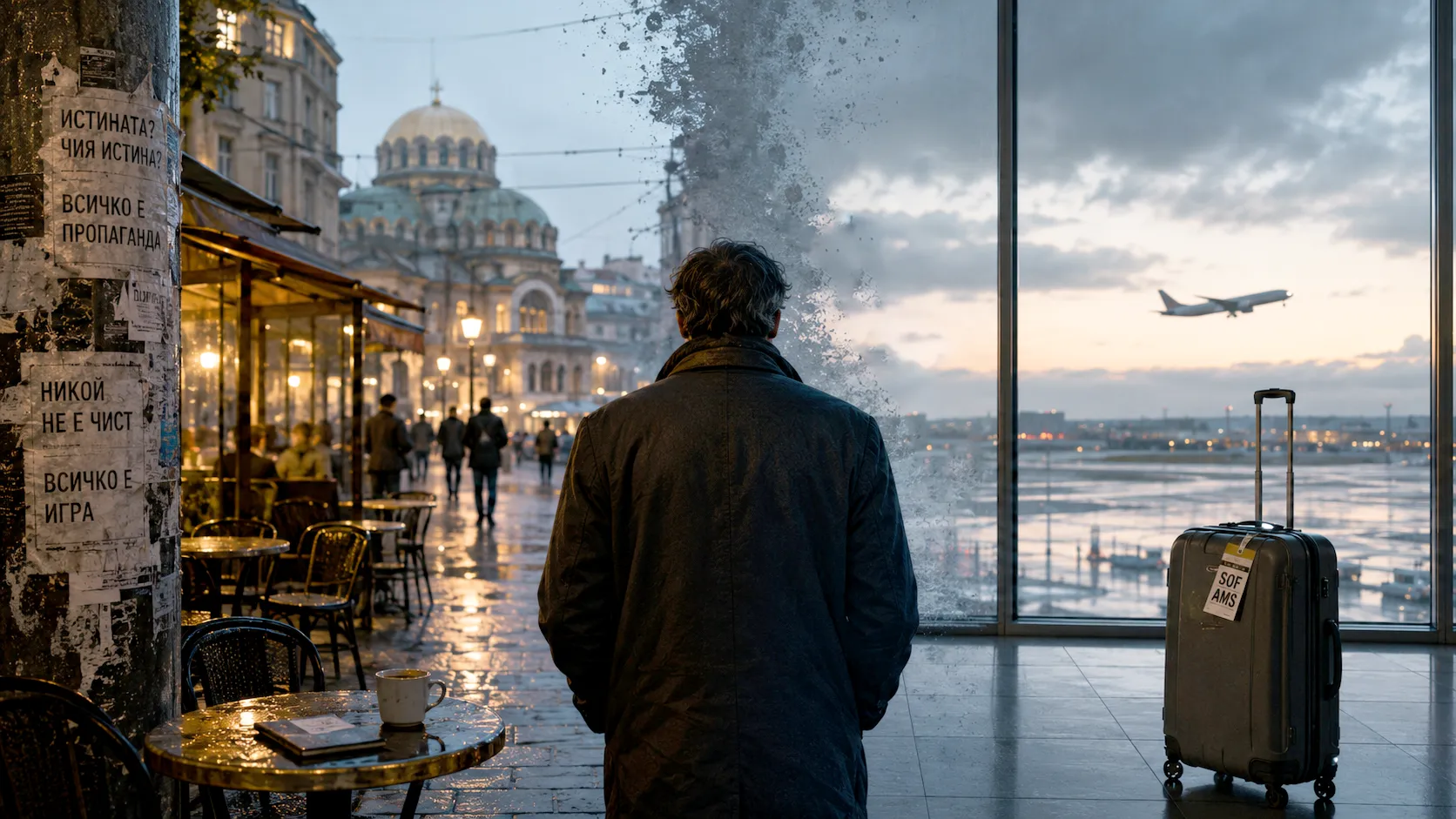
Some time ago, I read Maria Stepanova’s essay The Suitcase of Language, published in Equator. It had been a long time since I had come across a text that made me nod in agreement so often. Stepanova describes the fate of the new Russian émigrés after the war in Ukraine – people who left their country for political, moral, or simply human reasons, because they could no longer breathe in the atmosphere of an increasingly aggressive and inward-looking state.
At first glance, her world and mine have little in common. I am not Russian. Nobody forced me to leave Bulgaria. I was not fleeing war, censorship, or political persecution. And yet, from the very first pages, I began to recognise my own thoughts.
I recognised the life lived between two places: the fate of a writer who continues to write in the language of a country in which he no longer lives, the gradual transformation of language into something more than a means of communication – a kind of suitcase in which one carries one’s former life. Above all, I recognised that difficult-to-explain division in which one has both left and not left; belongs and does not belong.
The more I read, the more strongly I felt that I understood what Stepanova was talking about. Both of us live outside the countries in which we were born, continue to write in our native tongues, and carry with us the distance that inevitably accumulates after many years away.
For a long time, the differences between us seemed obvious but secondary. She is a Russian writer; I am a Bulgarian one. She writes about an exile born of war and political catastrophe. My departure had nothing to do with such events.
And yet the feeling of kinship did not fade. At times, I had the impression that I was listening to someone describing an alternative version of my own biography.
Only later did I begin to suspect that the resemblance was deceptive.
***
A few weeks ago, I returned to Sofia for the launch of my latest book. I had not been back for almost two years. Such visits always have a peculiar rhythm: a handful of days filled with meetings, conversations, old and new faces, and the inevitable questions about how life is going and whether I intend to return for good.
The event itself went well. The audience included people with whom one could speak not only in the same language, but from within the same set of assumptions. That is a rare pleasure, one that becomes more precious with age. For two hours, we discussed history, politics, identity, and memory without having to begin every sentence from scratch.
The real experience began somewhere around all of that.
I wandered through the streets, met old acquaintances, listened to conversations in cafés and bookshops. I heard the same language in which I have been writing for decades. I understood every word. And yet, little by little, I began to feel that I was observing a world whose inner rules were becoming increasingly difficult for me to decipher.
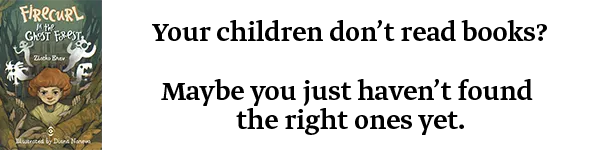
It is hard to describe this feeling without sounding either arrogant or absurd. It was not about politics or disagreement. Over the years, I have spoken with people from many different countries and grown accustomed to accepting differences as something natural. This felt different. It was as though I kept running into an invisible barrier that I could not quite name.
The more I tried to grasp its nature, the more elusive it became. Nobody was hostile to me. Nobody drove me away. Nobody told me that I did not belong. And yet, for most of my stay, I felt like someone who had accidentally landed on another planet.
The strangest thing was that it was not my mind reacting this way. It was my body.
Within the first few days, I began to notice a small, almost ridiculous detail. I was eating constantly, not because I was hungry. I simply kept wanting to put something in my mouth. Pastries, sweets, coffee – half an hour later I would be looking for something else to eat. The food brought me no pleasure. If anything, it merely dulled some nameless inner tension.
This is not my usual behaviour. In Berlin, I have lived for years according to a fairly strict routine, and I know perfectly well the difference between being hungry and merely wanting to eat. But here, that distinction seemed to disappear. My body kept demanding more, and I obediently complied.
There was something else.
For most of the visit, I felt as though I had had one or two glasses of wine too many. Not enough to lose control. I could work, hold conversations, do everything I needed to do. But I was haunted by a constant sensation of haziness, a slight inner instability. It was as though the ground beneath my feet was not entirely solid.
At the time, I paid little attention to it. I explained it away as stress surrounding the book launch, the journey itself, lack of sleep. Yet gradually I began to notice something curious. Every morning, I woke up thinking about how many days remained before my departure.
It wasn’t that I wished to be elsewhere, or that I felt uneasy or threatened. Some part of me simply kept taking stock.
Four days left. Three. Two.
Later, a strange image came to me. It was as though, throughout the entire visit, I had been carrying on a silent conversation with my own body.
It kept saying: Get me out of here.
And I kept replying: Relax. It’s only four days.
Only after I returned did I realise the absurdity of that exchange. My body could not possibly know that it was only four days. I was the only one who knew.
Perhaps that was why its reactions were so primal. My body knew nothing of political analyses, had never read Maria Stepanova, and cared little for questions of identity or exile. It had simply found itself in an environment that, for reasons it could not explain, it experienced as foreign.
Only afterwards did I begin to notice a recurring pattern.
Almost every conversation, regardless of its subject, seemed to slide very quickly into negation. Not disagreement – disagreement presupposes common ground. Rather, a kind of prior distrust. Politics became a search for hidden interests, history an exercise in explaining why no source could truly be trusted, and discussions of ‘society’ almost invariably ended with the conclusion that everything was corrupt, meaningless, or doomed from the outset.
In itself, this is hardly unusual. Scepticism is a valuable quality. The problem begins when doubt ceases to be a tool and becomes a way of inhabiting the world. Gradually, I began to feel that, in many of these conversations, the highest intellectual virtue was not the ability to construct an idea, but to dismantle one – not to offer a better explanation, but to demonstrate why every explanation is ultimately suspect.
From the outside, this can look like admirable critical rigour. Sometimes it genuinely is. But after a while I began to sense something else. Beneath the irony and the eagerness to debunk lay not intellectual confidence, but distrust: distrust of institutions, of history, of politics, of other people, and sometimes even of the very possibility that human beings might engage with one another in good faith.
And so I began to wonder whether my sense of estrangement stemmed from something deeper than simple absence.
That was when I found myself thinking about Maria Stepanova’s essay again.
Until then, I had read it as an account of a familiar world: people living far from their countries, writing in their native languages, gradually becoming citizens of an intermediate space between different cultures and biographies. But the more I reflected on my experience in Sofia, the more clearly I saw that the similarities between us were largely superficial.
Maria Stepanova knows what she has lost: her country. Not in the geographical sense. Russia still exists on the map. But the country to which she might once have returned as a writer and a citizen no longer exists for her. War, repression, and moral catastrophe have rendered such a return unthinkable.
Her entire essay is organised around a clearly identifiable loss. What lies behind her, where the pain originates, what has been destroyed – all of this remains clear to her.
The more I reflected on my own sense of estrangement, the harder it became to answer the same questions.
I have not lost Bulgaria. Bulgaria is still there. I can board a plane and be in Sofia within two hours. I can speak Bulgarian, publish books, meet readers and friends. There are no borders preventing my return, no secret police pursuing me. Nobody forbids me to say whatever I wish.
And yet the sense of loss was real. It was at this point that I began to suspect that Maria Stepanova and I were not speaking about the same kind of exile.
She had lost a country. I was beginning to fear that I had lost something far more difficult to name. Not the country, but my people.
For a long time, I could not bring myself to formulate that sentence. It sounded too melodramatic, too vague. What does it mean to lose one’s people? My friends, my family, my readers – they are all still there. They have never disappeared. We still share the same language.
Yet the more I tried to define what exactly I was missing, the clearer it became that I was not speaking about particular individuals, or a circle of friends, a generation, even compatriots in the conventional sense.
Every conversation begins from a certain place, whether the participants are aware of it or not. There are assumptions that remain unspoken because everyone takes them for granted. There are shared understandings of what constitutes truth, evidence, fact, or argument. Without such foundations, disagreement remains possible, but conversation gradually becomes something else altogether.
This, increasingly, was the feeling that accompanied me throughout my stay in Sofia. It was not that the people around me were unintelligent, or that we did not share a common language. The problem lay deeper. More and more often, it seemed that we were speaking from different premises without even realising it.
The difference emerged in our attitude towards history, politics, or the most ordinary matters of everyday life. The subjects changed, but the sensation remained the same. Every idea first had to justify its own existence. Every claim had to defend itself against the suspicion that it concealed some hidden agenda.
It was here that my story began to diverge from Maria Stepanova’s.
The more I thought about it, the more uneasy I became with the very phrase I have lost my people.
Stepanova knows what she has lost. Her essay is organised around a clearly visible boundary. On one side lies Russia; on the other begins life in exile. However complex the moral and political dimensions of that separation may be, the separation itself is unmistakable.
My own experience feels different. If I were asked, honestly, when exactly I lost these people, I would have no answer. There was no rupture, no conflict or drama. Nobody expelled me from a community. Nobody told me that I no longer belonged.
Perhaps this is the essential difference between the two kinds of exile. The political exile usually knows what he has lost. He can point to the event that interrupted his former life. He can name its cause. Even as he navigates between different identities, he knows where he comes from.
My own experience resembles something else: the gradual realisation that you have been walking alongside other people, convinced that you are all heading in the same direction, until one day you look up and discover that almost nothing remains between you except a common language.
The longer I reflected on this, the more insistently a disturbing thought began to haunt me: what if the loss had not happened now at all? What if what I experience as loss is merely a delayed recognition? What if the people I have been searching for never existed in quite the form I imagined them?
The question was so unsettling that, for a long time, I preferred not to ask it. Because it calls into question not society itself, but my own image of it. It asks not what happened to others, but what exactly I had been seeing all those years.
Of course, one has to tread carefully here. Take one step further, and the entire reflection turns into the old story of the misunderstood intellectual blaming society for his own loneliness. Such stories are as old as the world and seldom deserve much attention. The question, therefore, is not whether I was right and everyone else wrong. It is a different question altogether: what exactly have I been searching for all these years?
For a long time, I thought I was looking for agreement. Later, I realised that could not be it. Few things are more tedious than a society in which everyone thinks alike.
Then I thought I was looking for an intellectual milieu. But that did not quite explain it either. I have known brilliant people with whom I could hardly talk for half an hour, and others with no special intellectual interests in whose company an entire evening simply flew by.
Gradually, I began to suspect that what I was looking for was something both simpler and much rarer: a shared world. Not one without conflicts or disagreements, but one in which people still assume that reality exists independently of their fears and desires, and that conversation is a way of exploring it rather than merely a weapon in the struggle between competing groups.
Perhaps it was precisely the absence of this shared assumption that unsettled me so deeply during my last visit to Sofia. Not differences of opinion or political loyalties, but the feeling that common ground itself was increasingly being called into question. That history was merely propaganda, facts merely perspectives, every public position a mask for hidden interests, and every institution a fraud.
In such an environment, critical thinking gradually loses its role as a tool for separating truth from falsehood and begins to erode not only illusions, but also the very conditions that make meaningful conversation possible.
What struck me, looking back, was that Stepanova’s essay follows a very different path.
In a sense, it is an essay about hope. Not political hope – she is far too clear-eyed to believe in swift historical resolutions. The hope her text offers is of a different kind. It lies in the gradual discovery of a new community: people who live between languages, countries, and biographies.
By the end of the essay, this is precisely where she arrives. At a new form of we, grounded not in origin, territory, or national identity, but in shared experience. Russian, Ukrainian, Belarusian, Iranian, Sudanese – it makes little difference. What matters is that this experience exists, that it creates bonds, and that it gives rise to a sense of mutual recognition.
Perhaps this, more than anything else, is why her essay affected me so deeply. Because throughout my reading I felt not only agreement, but something else as well.
I felt envy.
Not envy of the exile’s fate. There is nothing enviable in that. What I envied was clarity.
Stepanova knows what she has lost. And she knows where to look for its replacement. Even when she writes about uncertainty, the direction of her search remains unmistakable. She is moving from one we to another.
I am not sure that I can say the same about myself.
The older I become, the harder it is to find such a community. Not only in Bulgaria, or among émigrés, or among people who share my political convictions. More and more often, I feel as though I inhabit a number of partially overlapping worlds, none of them possessing sufficient gravity to become a genuine we.
Perhaps that is why my experience in Sofia unsettled me so profoundly. It showed me not that I had lost my country, but that I was becoming less and less certain where I end and we begin. And that is an altogether different kind of loss.
Of course, Maria Stepanova may be right. A new kind of community may indeed be emerging before our eyes – one whose members will never share the same nationality, history, or even language. People who live between countries and cultures may eventually discover that they have more in common with one another than with their compatriots.
I do not know.
What I do know is that, after my last journey to Sofia, I began to see both my own life and Stepanova’s essay differently. For a long time, I regarded emigration as a relatively straightforward fact. One leaves one country, settles in another, and sooner or later is forced to answer the question of where one belongs.
I am no longer convinced that this is the most important question.
A more important one, it seems to me, is this: what happens when your country continues to exist, but your sense of community gradually fades away? What happens when you can return to every place in your past, yet find it increasingly difficult to recover that space of shared assumptions which turns a group of people into something more than a mere collection of individual lives?
There is probably no universal answer. Some of the reasons may lie in society itself. Some may lie within me. And perhaps such divergences are simply the inevitable price of a life lived long enough.
Whatever the reason, the result is a strange one. It seems that a person may experience not one kind of exile, but at least two.
The first begins when you lose your country.
The second begins when you are no longer certain who your people are.
